Monday, 5 March 2012

Hong Kong and the Philippines Part 5: Bagiou, Montalban and Manila


Greetings!

This week may I proudly present to you all the last installment of my Filipino travelogue from way back in 2002. Next week I hope to start introducing my Balkan epic but in the meantime, lets journey to Bagiou, the summer capital of the Philippines and home to a man named Bert with a daughter called Criselda...
 
Keep travelling!

Uncle Travelling Matt
Links to all the parts of this travelogue:

Part 1: Hong Kong

Part 2: Manila and Lapu Lapu

Part 3: Cebu and Bohol

Part 4: Vigan, Badoc and Batac

Part 5: Bagiou, Montalban and Manila


We arrived in Baguio, the summer capital of the Philippines, just past two in the morning, just over an hour later than anticipated, (I say 'anticipated' as opposed to 'scheduled' as I'm not sure that a schedule actually existed). Our host in the city was a Mrs. Victoria Sebastian, a lady whom apparently would meet us at the bus station. Quite who Mrs. Sebastian was, we knew not. Arlene had organised the whole thing, but we assumed that she was the mother of one of the girls whose names we could never quite remember, (but whom I said I knew from church, since the chances were that I'd probably seen them there). Whoever she was however, one thing that she wasn't was at the bus station which left us with a dilemma as to where to spend the night. Cris Corpuz had said that he would call her, maybe he had, maybe not, but it mattered little. She wasn't there and we needed beds. What's more, the bus to Baguio, like the bus to Vigan had zapped us with it's hard-core air con, and I for one felt positively ill.
"What shall we do?" queried my companion of a travelling nature.
"I don't care, let's just get a taxi driver to take us to the nearest hotel, we'll sort it out in the morning."
And that is what we did, our friendly driver took us to his friend's hotel, an establishment named New Belfranlt, and there we procured a room for twice what we had paid in Manila, (to be fair though, it had twice the number of beds since it was actually a family suite, all that they had left), and we both fell fast asleep.
 
Bagiou
 
The next day we awoke and breakfasted at Jollibee's, the Philippines' considerably superior answer to McDonalds. We then phoned up Mrs. Sebastian who arrived shortly afterwards in a taxi and took us to her abode nearby. The Sebastian house certainly was a fascinating place, perched precariously on a hillside, (most houses in hilly Bagiou are), it was a warren of passage with uneven floors and walls that were not parallel. We assumed that perhaps they built it themselves and it looked like it may fall down at any minute, yet we later learnt that during the terrible earthquake that had struck the town in 1990, whilst the concrete hotels came tumbling down, the wooden houses merely wobbled a lot and stayed standing.
 
We got talking to Bert, Victoria's husband who was a knowledgeable and a chatty guy. Like many Filipino's he'd lived abroad for many years, though unlike most of his compatriots he was at the top end of the scale, a boss not a worker. Bert told us that he's worked for a British-American company that supplied the military. Quite with what they supplied the military he never said but I assume it was nothing more exciting than foodstuffs. Amongst other places he'd been stationed in Ho Chi Minh for several years, (then it was Saigon he informed us), Indonesia, Germany, Guam and Singapore. He's also travelled extensively outside of his many workplaces, Hong Kong, Thailand and the States being just three destinations. And of course he knew Japan well, and our own prefecture of Toyama, for it was there his daughter lived, married to a Mr Yamaguchi whom she had met in the Philippines. Once more this was a Filipina that I had no recollection of, (though with the name 'Criselda' I should have remembered her), but Bert didn't seem to mind, being far to busy talking about anything and everything.
 
I liked Bert I must say. I have a thing for old people who talk non-stop anyway and he certainly had some interesting things to say. He told us how he had the deepest respect for the many Filipinos who work abroad doing menial jobs. "These are university graduates," he explained, "yet they swallow their pride and accept work that is below them just to help their families. You gotta admire that I think." He was right, how many people back home would do that?
 
With Bert in Bagiou
 
One opinion he did profess that I did not agree with was regarding the Japanese. They do not have a great reputation in the Philippines it's true, (considering the war it's perhaps not surprising), yet what Bert was complaining about was that they were lazy regarding other languages. "Because they have so much money they think that they don't need to learn English" he said, "but it's the international language. We learnt it, why shouldn't they? But they can't be bothered, it's laziness." That opinion is a popular one, not only in the Philippines but across the globe, and it's understandable since the Japanese do have some of the worst English on earth as a rule. But I feel I must state here and now, that laziness is not the cause. Having seen the Japanese trying to learn English I think of few nationalities that try harder. The sad fact is that, whether due to bad teaching, the differences between their language and ours and shyness I know not, but the Japanese are just not very good at English. They try hard but simply cannot do it. Lazy however, they are not.
 
We spent the rest of that day exploring Bagiou with the help of Bert's youngest son and his mate who owned the taxi which we travelled in. The son, whose name I know not was, unlike his father, a quiet lad who was only about sixteen and had a worrying habit of listening to rap, as opposed to all the good music that was obtainable in the Philippines (such as Angelina). His mate however was a jovial, rotund fellow of around twenty-eight who had once worked in a bank but preferred taxi driving as he was his own boss. He was a great guy who knew where to go and what to see.
 
He took us first to the PMA, (the Philippine Military Academy), a huge army base where all the officers for the national armed forces are trained. We wandered around the barracks and training grounds, and climbed all over guns tanks and helicopters, before moving onto Camp John Hay.
 
Camp John Hay had been an American Army Base until several years ago, and was now being transformed into Club John Hay, an area of beautiful tree lined streets with holiday homes, expensive mansions, a golf course and a reserve for the Igorote people, the natives of Baguio. "Actually," our driver informed us, "I'm proud to say that I'm Igorote myself, but like most people I live as a normal Filipino. We stopped for photos with some old guys in the native dress before moving onto a photo opportunity in front of the President's summer palace.
 
It was then up to Mines View Park, an area teeming with souvenir shops and Filipino tourists. This spot was popular for the view across the valley to the gold mines in the nearby hills, where we once more had a photo moment. Perusing through the souvenir shops I also bought some of the typical tourist junk which although tacky, is just to my liking and what's more, great as teaching aids for the inevitable Philippines Lesson back in Japan which would no doubt occupy most of January.
 
Mines View Park, Bagiou
 
But time was short and the light was fading so it was swiftly into the taxi once more and onto the Bell Church. Despite it's name, this is no Jesus orientated building however, but another Chinese temple akin to the one we visited in Cebu. When we arrived we luckily bumped into a school friend of our driver, who was half Chinese and at that time doing some renovations to the complex. He explained the rituals and how the complex is dedicated to the worship of a mixture of Buddhist, Taoist and Confucian elements. Such pick 'n' mix religion just doesn't occur in the West, but seems to be the norm in the Orient, just look at Japan where the population have no qualms in being Buddhist and Shinto at the same time. Inside the temple I once more asked the Gods for some advice through a process of lighting incense, picking a numbered stick and through some divine bits of wood on the floor. The answer however that I received was the opposite to what I had received in Cebu which brings me to doubt the power of the be-whiskered sages of the East, but I enjoyed the experience nonetheless.
 
Bell Church, Bagiou
 
After driving through a valley named la Trinidad where apparently a lot of salad vegetables are grown we returned to the city and the highlight of our day, the cheap CD shops. It was there that I purchased Angelina and several other cracking discs. And at a quid a time, I for one didn't feel ripped off.
 
That evening we headed into the city again and wandered the streets, eating a small out of the way restaurant, (25 pesos for a set meal), and purchasing various bits and pieces, including a camera and more cheap CDs. Satisfied with our day we returned back to the higgledy-piggledy guesthouse which was complete with Bert who chatted for some time before we announced that we were to turn in for the night.
 
 
The following day we had anticipated being more than occupied with the not-so-simple task of getting to our next port-of-call, the house of the Borres family where we were to spend the New Year. The problem was that not only did we not know when the buses ran, but we also did not know where the house was, except that it was in Rizal Province. Thankfully, all our woes were solved by the arrival of a daughter of the house that morning. She'd come home for the New Year from manila where she lived and worked. She'd journeyed north in the taxi of a family friend, and the driver had to go back to the big city that day. Why not accompany him and pay him a little money, thus making his trip more worthwhile and saving us both time and money. That suggestion we hurriedly accepted and so it was that we set off from Bagiou in the taxi of Alex.
 
Like Badoc we were sad to be leaving the beautiful mountain city so soon, as it seemed like it had lots more to offer, but the journey back was beautiful, through the mountains which reminded me a lot of those in the Balkans, (incidentally, the city itself was rather similar to a Balkan town I thought). Alex, although not a man of many words, was good company and the local radio station was playing a non-stop 48 hour session of Beatles tunes so who could complain?
 
As the mountains flattened out, the world outside got less interesting and I settled down and read Alfred A. Yuzon's Great Philippine Jungle Energy Cafe, a brilliant novel about a Filipino revolutionary hero who had god-like powers and ended his life in a café in the jungle alongside all the great Filipino heroes, John Lennon, James Dean some French writers and a couple of South American revolutionaries. All very strange but good stuff nonetheless and interrupted only by lunch at Jolibee.
 
Near Manila, our chauffeur rang up Mrs. Fely Borres, our hostess to be and worked out where he was to go. It turned out that our destination was not far from Manila itself. The route there however was interesting. Whilst Alex chatted about his time working in the UAE, we passed the head church of the Filipino Igelsia ni Kristo sect, and then through the fascinating yet heart-rending locality of the Smoky Mountain, the city's rubbish dump which is populated by thousands who scavenge the smoking hill for useful bits and pieces to recycle.
 
Montalban in Rizal Province was a rather nondescript town, perhaps typical of a Filipino suburb. We halted by the Holy Rosary church on the main thoroughfare and picked up the diminutive Fely Borres who then guided our not-so-diminutive driver to her home.
 
The Borres house interested me as I imagine it is typical of a Filipino home in the town, in the same way that the Corpuz house was probably the norm for the countryside. It was small yet had all one needed including running water and electricity which are things that the Japanese wrongly suppose other Asian countries don't have. What was most interesting however was that it had to be the most religious place I had ever set foot in. Pictures of Christ or Mary, prayers and crucifixes filled every available space and I slept that night under the auspicious eye of Saint Augustine. Filipinos, being Catholic are pretty into religious trinkets as it is. Every taxi had a rosary dangling from the rear view mirror and every home had at least one Chirst and Mary. The house in Bagiou even had a room that looked like a small chapel but this places was something different, yet despite being cluttered the atmosphere was nice.
 
The Borres family are of course among the faithful. Mildred as I mentioned earlier, had considered becoming a nun and her only sister, Mayleen was actually in the convent at the time. Whilst we stayed Fely went to Mass everyday, something that we didn't manage I'm ashamed to say, no amount of piety came empower me to wake at five o'clock in the morning!
 
Fely, like her daughter was quiet and perhaps a little shy but we soon got talking and looking through numerous photo albums of the family in earlier days. Time passed quickly and in no time at all it was time for the evening meal which consisted of some delicious barbequed chicken, Filipino style.
 
That evening was New Years and Fely was going to the Mass. We decided to accompany her to the Holy Rosary Church which like all the others was overflowing by the time we arrived. We walked the short distance from the house through the local cemetery, an eerie place where the dead were placed in concrete tombs, one on top of each other, Spanish style. The Mass itself was in Tagalog, but we listened anyway and afterwards met up with some friends of Red who were members of the choir. They, like their friend in Japan, were friendly and welcoming and we enjoyed chatting we them. I also met with her old history teacher, a fascinating fellow who certainly knew his stuff. He talked at ease on British, Filipino and American history and also the histories of different Christian sects.
 
With the servers at the Holy Rosary Church, Montalban
 
Outside the church, the New Years celebrations were already well underway, with firecrackers continually exploding above the streets and whole family sat outside their homes listening to loud music blaring out from the radio. Fely's friend Myrna turned up after a while with her young nephew and Red's friend Jerry. She was another fascinating person, at home only for Christmas and normally residing in Singapore. We went outside, watched the fireworks and lit some of our own. Filipino firework safety levels are not those of the UK, kids were going back to ones that had gone out or people launching fireworks into electric cables. No one was hurt however, as is the norm, the horror stories we are told about such practices are to dissuade us from following them rather than present an accurate picture of the risks involved. We watched the celebrations in the Borres street for sometime and then walked around the town causing many bemused glances on the faces of the locals, (two foreigners, here, why?), before returning back to the house ending what had been a relatively quiet yet pleasant New Year's Eve.
 
 
Both still tired from all the travelling and strange sleeping hours, the following day was low key. Back in Japan, I'd been presented with a shopping list by approximately half the Vietnamese community in Osawano, of things to buy them in the Philippines. "Japan very expensive, Philippines no expensive you know?" being the explanation. On top of that, my auburn locks were getting a little too long, so that day we headed of to the Santa Lucia East Centre with Fely and Myrna, in Jerry's taxi.
 
One thing that did surprise about the Philippines is how big shopping centres are there. Everywhere we went, from Manila to the provinces, there was an SM, Robinson's or Ayala Centre, air conditioned oasises of Western life in the midst of the dirt and turmoil of the Third World. I am actually not a big fan of the shopping centre, I prefer to avoid them if possible but it was difficult to do so since all the Filipinos we were with gravitated towards them, Fely and Myrna were no exception. Whether most Filipinos can afford to shop in them regularly I rather doubt, perhaps the attraction is rather like those people who go to Harrods and buy the smallest thing that they can find, just so they can get a carrier bag, I don't know. What's more, Filipino shopping centres are less appealing to me than most, due to the irksome security checks at every entrance; evidence of how jittery the country was after recent terrorist attacks by the Abu Sayaff (Islamic Freedom Fighters) in the south. However, every cloud has a silver lining and in Filipino shopping centres it's the food courts. The problem with foreign foods is that whilst I like most of it, (particularly Filipino I may add), I don't know the names of the dishes. How does one order something if you don't know it's name? It's pretty bloody difficult I tell you. But in the food courts, that's no problem since all the dishes are laid out in front of you, so you just point like good tourists do worldwide.
 
One thing that I always make sure to do when away from Japan is to get a haircut, for the simple reason that it is so expensive there, around 3,500 yen (about 18 pounds for a cut), thus our first port of call was the hair salon. To be honest, in comparison with the wash, shave and cut I received in Vietnam for the grand price of 70 pence, this was a little disappointing. No shave, and the charge was just over a pound. Still, compared to Osawano value I couldn't complain, plus the time sat in the barber's chair gave me an opportunity to peruse the Filipino versions of Woman's Own, where I learnt that women who are contemplating affairs should stay true to their husbands, but girls whose boyfriends do not pay them enough attention should dump them fast. What's more praying together helps a family to stay together, but a make-over too can give one's self-esteem a big boost. Fascinating stuff, but sadly the haircut had finished by the time I had reached the article on breast implants and so newly-trimmed and brimming with feminine knowledge, I set off to shop.
 
Whilst most of my female friends’ mouths’ start watering at the prospect of shopping for labelled goods in a very cheap country mind does not. The fact is that I hate all shopping except for books and CDs and this was not something that I was looking forward to. It was also not something that I really knew how to do, shopping for female clothes when you are a bloke is an alien enough experience as it is, when all the sizes are given in centimetres whilst the Philippines works in inches made it all the more difficult. Happily, Myrna had opposite shopping emotions to me, and she enthusiastically trailed around boutiques, department stores and shoe shops until in no time at all we'd finished.
 
Pleased with the progress, I bought I snack to celebrate and we headed off back to Montalban to pack the precious new purchases.
 
 
Having spent a relatively quiet New Year's Eve, Ryan and I decided that we should go out that instead. In retrospect, January the first was not the best date to choose for a night on the razzle since we later found out that many places were closed, but we knew that not at the time and whatever the case, we both needed a drink. However, neither of us are experts when it comes to knowing where's hot and where's not in Metro Manila, so to assist we phoned up Randy and asked him if he'd like to accompany us.
 
Mr Aquino however informed us that, so sorry, but he was busy early the next day, and so could not really afford a late night. he did however recommend that we head towards Makati, and so taking his advice, off we went catching a jeepney for the hour long ride into town.
 
Makati is Manila's business district, rather like Shinjuku in Tokyo or the city in London. I'd noticed it previously from the MRT, it's hard not to for it has the tallest buildings for miles around. Stepping out of the MRT station was strange. The place was so unlike the rest of Manila; no dirt, no choked streets, no crumbling buildings, instead pristine glass skyscrapers with well-tended lawns at their base. It was like a little bit of Japan transplanted in the Philippines.
 
We headed towards the bar district and stopped at the first pub. It's name was Titanic Club but what really impressed Ryan was that it was written in katakana, the Japanese alphabet for foreign words.
 
I feel I must tell you here and now about Ryan and Japanese. Now, I have a so-so relationship with the language, I learn it because you need it if you're living in Japan. I don't really have a passion for it however, and that couple with the fact that I am a lazy git means that I'm not quite as fluent as I should be.
 
My companion however is the opposite. We are are talking someone who would breath Japanese if he could, and he is certainly a role model for those who want to know how much you can learn in a year or too. Not only does he like studying it, but he likes speaking it too, which is where he was a bit stuck in the last week or two, since his chances to speak nihongo in the Philippines had been virtually nil. For a start the locals don't speak it. On top of that, they don't want to learn it, and so our suffering linguist is left me me, who has a pretty bad command of the tongue at the best of times and was actively avoiding speaking it whilst abroad. This probably explains why Ryan then suggested, "Let's go in here?!"
 
He was not disappointed, and indeed nor was I. Ryan was not disappointed because all the staff spoke Japanese and Japanese TV was showing on the set by the bar. I was not disappointed because all the staff were female, attractive and wore fetching sailor suits with rather short skirts. Yes, indeed, it's seems that we'd stumbled on a hostess bar.
 
Hostess bars are big in Japan. Contrary to one some foreigners think, they are not brothels, instead the idea is that the guy goes in and pays for an attractive girl to talk to him and pour him drinks. Japanese society had many differences from ours and one of them is that people tend to socialise not with their spouse, but with their company. Therefore, it is common for the Japanese man to go out drinking with colleagues at the end of the day, and pay for a girl to listen to the trials and tribulations of his day at the office, than for his wife to do that at home.
 
I'd never been to a hostess bar before for several reasons. Firstly they are expensive, starting at around 5,000 yen (25 pounds), a go, and that's without the drinks. Secondly, if I needed a girl to listen to my woes, (and I do not since we Westerners tend to have more cross-gender friendships), then one in a Japanese hostess bar would be no good for me, since they don't speak English.
 
We only stayed there for two drinks, but it was nonetheless an interesting experience. The girl we talked to was nice and sounded interested in what we had to say even if she was not. To tell the truth, she may well have been interested, after all we were not Japanese businessmen, so I suppose it was some variety for her if nothing else. She was particularly surprised when she asked us where we were staying. Expecting to hear Makati or Ermita, she looked shocked when we replied Montalban.
"Montalban! Why would you want to go there?"
"We have friends there, Filipinos."
"Oh, but it's a long way."
That was something that we couldn't argue with, after an hour in the jeepney we'd both felt a little wheezy. We asked her what she did and she said that she was a student of psychology and she worked at Titanic to help pay her way through college. What was nice was that there was no pressure to buy her drinks or take her home afterwards like there had been in Cebu, and the place did not have a sleazy air. I can quite see why it appeals to the Japanese, though whether I'll ever bother again I doubt. The idea of paying someone to talk to me still rankles a bit.
 
Next up we went to a place called Cable Car, a standard bar with cheap beer. We stayed there a long time and chatted, before moving onto another place which had hip-hop music way too loud. Then we decided that it was time to head to the disco that Randy had recommended, Where Else? Unfortunately, when we got there Where Else? was elsewhere, or at least well and truly shut. It being two by that time anyway, we decided to call it a night and caught a taxi back to Montalban. That itself was an experience since it soon turned out that the taxi driver had the foggiest idea of how to get there, and he kept stopping and asking people by the roadside, but eventually we pulled up by the Holy Rosary Church, and trudged back to the Borres house and bed.
 
 
On our final day we had decided to take the advice of my predecessor in Japan, Matt Chapuis and take a visit to Corregidor Island. Corregidor is a small isle out in Manila Bay that gained fame during World War II as the base where General Douglas MacArthur resisted the Japanese invaders for several months in 1942. Now the ruins of the military complex are preserved as a museum. It sounded good, so we took a jeepney from the Holy Rosary Church to Cubao from whence we changed to a taxi. Our driver for that journey was probably the best we had. For a start, unlike so many others, he didn't try to rip us off by pretending that his meter was broken, and secondly, he gave an interesting commentary on all the places that we passed. "Look, there's Makati to the right" he announced, "and this highway was built during the Ramos Years.... That building there used to be the Paco Railway Station, but it's broken now." That was the understatement of the year, it looked like a bomb had hit it, though you never know, with all the terrorists about, perhaps one had.
 
He dropped us off at the quay but to our dismay, despite assurances that there were hourly ferries to the island, there were not. In fact there were only two daily and the latest left at half past ten in the morning. It was now almost two, what were we two poor tourists to do?
 
The answer presented itself when we examined the guide book and discovered that adjacent to the quay was the Cultural Centre of the Philippines, a concrete monstrosity designed by a famous Filipino architect, (so famous that I suspect he never worked outside of the Philippines). What's more, this palace of cultural delights housed a museum. Why not check it out?
 
The Cultural Centre was as ugly inside as it was out, one of those hideous dark edifices that architects considered pretty cool in the sixties. The museum was ok though, the most notable exhibition being a display of musical instruments from around Asia. The Art Gallery however was too weird, one room full of empty carrier bags and a another full of nondescript pieces of timber. Call me a uncultured, I care not, I stick to my belief that modern art is on the whole crap, and the stuff in the PCC was no exception. There was however a shop which was notable in the respect that it sold stamps. This was the first place in the whole country that we'd seen that did, and we'd not encountered a post box either, so hungrily we purchased some to put on the postcards that we'd bought back in Bohol. We never did find a post box however, in the end we gave the cards to Mrs Borres to post.
 
 
So, we had half a day left and no obvious way of filling it. Neither of us were interested in more museums, nor did we have the time or inclination to head out of Manila for pastures new. There was however, a little mystery that had been niggling at me for quite some time, and so I asked Ryan if he minded occupying himself for a short while, (he did not), and I set off to solve it.
 
You may remember, back at the start of the holiday, I had resolved to visit the railway station and experience the delights of Filipino trains. However, upon arrival I had found a terminus where the only thing operating was the floor sweeper. However, Filipinos that I had since spoken to assured me that PNR (Philippine National Railways), was still operating, and indeed had the security guard not stated that I had better try the station down the line. Looking in the trusty Lonely Planet however, the only other station marked was the one that we had earlier passed in the taxi on the way to the Cultural Centre, a demolition site. Therefore, where was this mysterious rail hub where trains for the south of the island allegedly departed from? To further my heroic rail-orientated quest, I hopped on the northbound LRT, aiming to alight at the next station up from Tayuman, the Teutonic-sounding Blumentritt, where Lonely Planet marked a railway line but no station. The decision was a wise one, stepping off the LRT I spied it, down below, not only a railway station, but complete with a waiting train!
 
Of all the places that I had been in Manila however, Blumentritt was undoubtedly the most poverty-stricken. The streets stank of rotten vegetables and were strewn with litter. Ragged children ran around barefoot whilst their older brothers played basketball on a makeshift court. The state of the railway was no better, quite the opposite. Along both sides of the tracks were shacks housing whole families, and down the middle grew crops. The track was so uneven that I was surprised that any train could ever stay on it. Yet, the train in the station had disappeared, obviously it was useable.
 
Blumentritt Station was in fact exactly what I'd imagined a third world station to look like, akin to the pictures shown on the news of overloaded trains in India and Sudan. I went to the ticket office and found to my surprise that there was not only a schedule, but a price list too. The fares were ridiculously cheap, making even the buses look pricy in comparison; under 500 pesos (6 pounds), to traverse the entire line to the south. I waited around for a while and then bought the cheapest ticket on the list to add to my collection of railway tickets from across the globe. This took an inordinately long time since they had to reserve the seat and find out whether I wanted a reclining seat or not. I didn't have the courage to tell the lady that I was not even intending to travel, I just collected train tickets, that would have made me seem even more like the Westerner with money to burn than I did already. With my paper ticket in my hand I left the station and returned to civilisation via the LRT.
 
 
Our final task of the holiday was to meet up with Sheree Ann in Makati, (she worked there), where she was to present us with gifts for her sister in Japan. That was easier said than done however when we discovered that none of the phones took coins. To solve the problem we bought a phonecard from the nearby Bayan Telecom shop, but when we rang up there was no reply. What to do asked Ryan. Why not take the LRT to Edsa, (halfway to Makati), and then try again from there, before taking the MRT for the rest of the way. Ryan agreed that the idea was indeed sage, so LRT we boarded and at Edsa we alighted. Unfortunately, we discovered that whilst Edsa abounded with telephones, none were connected the Bayan Telecom Network. "I shouldn't worry" said I, "There's bound to be some Bayan phones in Makati."
 
How wrong I was! At Makati it turned out that there were no Bayan phones at all. In fact, it is highly likely that the only Bayan phone there is, was the one by the Bayan shop. Annoyed at yet another bad telephone experience, we cut our losses and bought a PLDC card, (the former national phone company). This time a Sheree Ann answered, and in no time at all we were sat in Wendy's Hamburgers, whilst Sheree Ann wrapped presents for her big sister. "She told me to wrap them properly" explained little sister as she wound wrapping tape around some tubes of toothpaste, but she won't be satisfied, she never is." She was right, her sister was far from impressed when the toothpaste was presented. "We always argue you know." I know full well, though from my extensive sibling experiences, it's always the younger one that causes it. To make things more exciting, I wrapped the packs of corn puffs in a big circular shape so that they resembled a doughnut clothed in packing tape.
 
Wrapping presents in Makati
 
Sheree Ann then gave us a little gift each, for which we said thanks, and then it was in a taxi back to Montalban. We let the Filipino do the bargaining however, and got the cab at half the price.
 
And thus, that was it. We received more presents for her daughter from Fely Borres and packed our bags. Then, we showered and read books until Jerry, Red's friend came in his taxi, (complete with Myrna who was as chatty as ever), at three thirty and took us to the airport, the first stop on our trip to Japan.
 
 
As you can probably guess from this rather lengthy account, the Philippines fascinated me and I had a most memorable holiday. To be fair it was made all the more enjoyable by the welcome we received by all the Filipinos we met, though in particular by Randy, the Sebastians, the Corpuz family and Mrs Borres. The willingness of them all to open their homes to two foreigners who let's be honest, don't even know their relatives that well, (and in some cases not at all), is a fine example of human kindness, that is often sadly lacking in the West. It is a sobering fact that whenever I have gone travelling, as a general rule, (though there have been some notable exceptions), the poorer the people, the warmer the welcome. I'm ashamed to say that a Filipino visiting Britain would probably not be so well-treated.
 
But, welcome aside, the Philippines is a fantastic place, a rich cultural blend of South Sea, Asian, Spanish and Western influences, tempered by the tropical sun. The Chocolate Hills are a world-class sight and I only wish that we'd had the time to see what is actually the number one attraction of the country, the rice terraces of Banaue. Still, two weeks is never long enough to see a country, and we did very well considering. I'll certainly be going back there however, not only to see the rice terraces, but I fancy taking the train from Blumentritt south, and of course, I'd like to meet all our new Filipino friends again.  I also must add here that Ryan was a good travelling companion. Perhaps not as genki and zany as Catherine and Jen had been last year, he on the other hand did not suffer from clinical depression whenever an airport approached. The Filipinos seemed to like him too, (particularly Sheree Ann one must add), and if he asked me to go somewhere with him again, I'd say yes. What he thought of me however, I know not; hopefully nothing too bad.
 
If there was a low point to the trip it was Cebu. Highly recommended by every tourist and Filipino, we were both unimpressed. Admittedly, our trip there was marred by the bad boat ticket experience, having a hotel miles out and being ripped off by the same hotel for phone calls, plus it was the only place that we went to where we had no contacts, but nonetheless, it was in my mind a pretty uninspiring city. I think the problem was that it seemed to have no centre, and no focal point. The area around the Santo Nino Basilica is probably the city centre but even there had an aura of suburbia. When we got on the ferry to leave, neither of us wished to stay for more. That was not the feeling that we had everywhere else however. The mystery is why it was so recommended, perhaps when people said 'Go to Cebu' they meant the island as a whole, not the city in particular, I don't know.
 
But overall we thoroughly enjoyed it all, and even the late buses, countless security checks, and toilets without paper we got used to and prepared for. It certainly will be interesting to come back in a few years though how things will change I don't know. In Vietnam I got the feeling that I was in a country that was going somewhere, fast. It the Philippines I did not. I imagine that if I returned in ten years time it will be much the same as I left it, a few cosmetic improvements maybe, and perhaps the new LRT line will have opened, but nothing major. Governments will tumble and rise, people will still pack the churches till they're overflowing. New churches will be needed and will be built, but the ambitious railway line to Mindanao will, I suspect, never get off the ground.
 
But, as George Harrison once said, "All Things Must Pass" and this trip was over, so onto the plane we hopped and back to Japan we went, the youth of Nippon beckons....
 
Written Osawano, Japan, 2002
 
If you enjoyed this travelogue, you might also like to read Two Weeks with Uncle Ho, Brother No. 1 and Ming the Merciless which covers a trip I made around Vietnam and Cambodia.

Monday, 27 February 2012

Hong Kong and the Philippines Part 4: Vigan, Badoc and Batac

Greetings!

I'm back from Poland now after sampling the delights of Krakow and the surrounding area. It was a brilliant week away and one that I'm sure will find its way onto this blog sometime over the coming year. However, for now, we're Pilipinas, not Polska and so let us head south to the mountain city of Baguio...

Keep travelling!

Uncle Travelling Matt
Links to all the parts of this travelogue:

Part 1: Hong Kong

Part 2: Manila and Lapu Lapu

Part 3: Cebu and Bohol

Part 4: Vigan, Badoc and Batac

Part 5: Bagiou, Montalban and Manila


We arrived in Manila mid-morning and took a cab right across town to Quezon City where all the bus stations are located. Randy had told us to head for the Dagupan Bus Station but when we got there we found that they did not run services to Ilocos Norte so instead we headed next door to Dominion Bus Services, (slogan 'Our buses are protected by angels'). They too did not run as far as Laoag, the destination that we wanted but they did go to Vigan, a town just south of Badoc, (where our hosts, the Corpuz family lived), so we booked onto their trip scheduled to depart at eight that evening. It been only the hour of two at that time however, we decided to leave our bags in the ticket office and head into the city for the afternoon.
 
Earlier I said that the Manila LRT had only one line. This is true, but to confuse matters, the city has another light rapid transit system called the MRT (Manila Rapid Transit?), which runs from Quezon to Edsa on the LRT line. The two are different since the MRT is private and the LRT state-owned but to the traveller the experience is the same, and so we walked along the dusty street, pass shops full of pirate DVDs and cheap cassettes to the MRT station.
 
The MRT is an interesting ride to take and a little pleasanter than the LRT since all it's trains have air con. Our journey took us through Quezon to Makati (the business district), and then onwards, over a river to the Edsa Terminal, (Edsa is famous as the place where the people rebelled and ousted Marcos). I consider both systems, both L and MRT's, (will the next one be the NRT?), as great ways to see the city as both tracks are elevated and you can can good views of the surrounded cityscape. We changed onto the older train there and went as far as the Central Terminal from whence we walked to Intramuros.
 
You may remember that we'd intended to visit the Spanish-walled city during our previous sojurn in the capital, only to be thwarted by the actions of a jeepney-riding pickpocket. I'd gone anyway, but Ryan was still green to the city's Spanish charms so it was his turn to look around there.
 
We went first to the Cathedral and once more it was filled with a wedding party, (I've never come across so many marriages in one holiday!), so we moved swiftly onto the Santiago fort.
 
San Pedro Fort in Cebu had been the smallest Spanish fortification in the Philippines. Santiago is the biggest so the contrast was interesting. Once inside we came across yet another wedding party, (they were having the reception in the grounds), but the place was still peaceful and pleasant anyway. Before coming I'd heard a lot about the dungeons where many notable revolutionaries had been held by the Spanish, Americans and Japanese over the years. When we found them however we were most unimpressed, no chambers of gruesome torture, just mere holes in the ground with an iron grille over the top.
 
One famous inhabitant of the dungeons had been a certain Jose Rizal. I'll forgive you if you've never heard of him before, no one has outside of the Philippines, but there is the main man without a doubt; the number one National Hero you might say.
 
Rizal was born 1861 and died, by Spanish musket fire, in 1896. He was many things, a scholar (it is said that he mastered twenty-two languages), a poet and essayist, a national hero and much more. Unfortunately, the Spanish who ruled the Philippines at that time didn't overtly like national hero type poets who publicised to the world what was wrong with their rule. That's why they shot him and that's why he's considered a superman to most Filipinos. His museum preserves his legacy well, there's copies of his writings, the cell in which he spent his last night and wrote his famous death poem, his shoes and glowing tributes to him in a multitude of tongues. The only downside was that there was also a guy at the end who required you to give a donation to the museum, something that I resented since the museum had been the best kept place I'd been to so far in the country anyway, and something makes me suspect that the Filipino government will keep it's bit of nationalist propaganda pristine with or without outside donations.
 
We walked a little around the walls and I was surprised that the fort had also been occupied by the British for two years in the eighteenth century. What they were doing there I never learnt. We left the fortress and took a taxi back to the SM shopping centre near the LRT station where we dined on Filipino fare before returning to the Dominion Bus Station.
 
We were given our first taste of Filipino bus travel in the bus station. The service was scheduled to leave at eight. With all passengers and the driver on board at that hour, it then sat there with the door open, and the choking air of Manila making me feel positively ill. Then, for no apparent reason, just after nine it started off on the long journey north. I was glad that the toxic fumes of the city were now excluded from the bus, but there was a new problem. We had been told that the vehicle was air-conditioned, but we were not warned how much. By the time we reached our changing place of Vigan, the capital of Ilocos Sud, we were shivering and chattering and wishing that we’d kept our coats and jumpers on our bodies and not in our bags.
 
Our miseries were not over by the time that we’d restored ourselves to a normal temperature either. It was around five in the morning, we had slept little if any, and our beds for the night/ day were still over an hour’s bus ride away. “When is the next bus for Badoc due?” I asked the rather delectable yet grumpy young lady in the ticket office.
“Who knows?” she answered with a shrug and a huff. “One hour, two..?”
So we waited, for more than two it must be said, and when our carriage onwards finally did arrive we climbed onto it in a semi-conscious daze that lasted throughout the remaining hour, our meeting with the Corpuz family, and the short trip to their marvellous country house, a traditional wooden Ilocano affair with fine fretwork and windows made out of the material that they have been made out of for centuries; sea shells. We mumbled our hellos and arranged to wake up around twelvish in time for a trip to a local sports event, before climbing those proverbial wooden hills and sinking into a deep sleep in that fine old house amongst the palms.
 
The Corpuz family home, Badoc
 
 
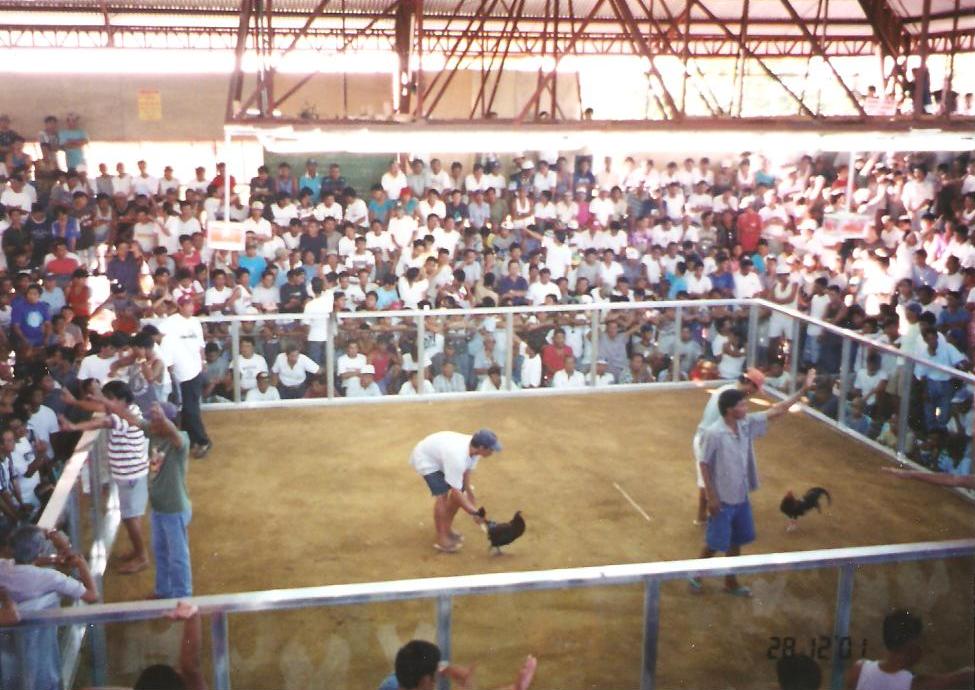
The cock pit was not what I'd expected. My only prior knowledge regarding the sport was that it used to be popular in Britain until it was banned sometime in the nineteenth century. It had actually been practiced in my home village of Draycott-en-le-Moors and a cock pit still exists there, now functioning as an unusual centrepiece to someone's back garden. The cock pit there is a circular mound surrounded by a ditch, several metres across. That's what I'd expected to find in Santo Dominguez, a circle of sandy ground surrounded by around twenty to thirty old men, betting on which cock would be killed first.
 
The reality was far different. We knew that we were there immediately due to the hundreds of cyclos parked along the road and in the field. Then there was the stalls selling everything from bottled water and beer to spit roasted pig and chicken kebabs, (no prizes for guessing where the chicken meat came from). And beyond all that was the stadium, a huge, roofed metal construction backed to the rafters with a vociferous crowd, one thousand souls minimum. And this was a small, rural cock pit!
 

Cock-fighting in Santo Dominguez
 
We parked up and walked through the hollering traders to the main entrance. We were confronted by a wall of people, with some of the younger and more agile clinging to the sides of the stand. There was absolutely no way that we could enter by that route, so we went around the back and climbed some rickety stairs to the top of the stand. It was also packed there too, but somehow we managed to squeeze in and get a look at the action.
 
If I were asked to describe what a cock fight is like as a spectator experience, I reckon that the best description I could give is as a cross between watching a football match in the good old days when standing was allowed at stadiums and a sumo bout. It was similar to the football since everyone was crammed, standing only, into a stadium that from the inside looked rather like a football stadium, albeit with a much smaller pitch. The cock it was square in shape and the stands led right down to the edge of the 'pitch' as one might say. What's more, like in a good football match, everyone was shouting very loudly.
 
The fight itself however was not a game. It consisted of bouts which lasted no time at all, rather like sumo. A good, lengthy cock fight will last three or four minutes, most others far less. Yet, the tournament goes on all day long. The one we were attending had started around noon and would last until around seven in the evening. It this respect it reminded me of sumo, countless short bouts in a long tournament.
 
The experience started when the two cocks were brought out and displayed to the crowd. The cocks pecked each other to incite hatred and it was then that the betting started. Like so many sports, the main purpose of cock fighting is the betting. The cock on the left was always viewed as the weaker, thus if it won, it was more financially rewarding. The big difference however between betting in the West and Filipino cock fight betting is that nothing is written down. Betters signal to the bookies, (who are lined up at the side of the pit), how much they are prepared to bet, and on which cock by the means of hand gestures which signify how many hundreds or thousands of pesos they are willing to risk. They also holler their family name, though one assumes that most of the bookies know this already, it being a small, rural community. The betting then subsides and the fight begins. The cocks are placed down in the ring and their owners retreat. For the first minute or so the cocks merely strut around, apparently not noticing each other. Then they fly at their opponent with a flurry of feather, the ones around their neck standing on end like an Elizabethan ruff, which makes them look all the more menacing. Usually the fight is over within a minute or so. The referee picks up the wounded cockerel and lets it peck and it's opponent. If it attacks, it is still alive and the fight continues. Usually however, it is dead.
 
Then the exchange of money takes place. The losers screw the appropriate amount of pesos tightly into balls and throw them down to the bookies, who then throw balls of pesos up towards the winners. Once this activity subsides, then it's time for the next bout.
 
I must admit that my visit to the cockpit changed my perceptions of the sport quite a lot. I am someone who is anti-blood sports and I'm not ashamed to make that clear. I have no doubt in my mind that fox hunting should be banned in Britain for example, and I still hold to the belief that banning cock fighting was a good thing. However, I must say that the sport is far less bloody than I expected. At the absolute most, the cockerel only suffers for two minutes or so, which is hardly that long and in my mind far more humane than chasing a fox for miles across open country or even fishing and leaving a fish to suffocate quietly or with a wound in it's mouth from a hook. No, there are worse crimes than cock fighting and why it has such a very bad reputation I am not entirely sure.
 
For me however, it is not a sport that I can ever see me getting into. The bouts are too short to get interesting and I am not a betting man as a rule, (I did of course have a go in Santo Dominguez and promptly lost 400 pesos), so the main attraction of the sport doesn't really appeal to me. Still each to his own I suppose and at the end of the day, I like to eat the finished product so I can't complain there!
 
And it is each to HIS own. In the whole one thousand plus spectators I only spotted five women. The one in our party stayed in the car and slept. Like football used to be, cock fighting a male domain, father and son go to the pit together, mother and daughter stay at home or chat to their friends outside in the market stalls.
 
 
After about an hour of bouts, my tired legs suggested that it was time to move on. I don't know if the males of the Corpuz family really wanted to go, (I suspect not), but they made no objection, so off we went to the next town, Vigan. Of course we had been to Vigan  before, but I couldn't say that I'd really seen the place and that experience was one that I'd rather forget anyway. What I didn't realise then however, is that Vigan was not just another provincial capital, it is instead the best preserved Spanish colonial town in the Philippines. With that on your doorstep more or less, how could you not visit it, yet Sheree Ann informed us that despite living only thirty miles or so away, and indeed passing through the place everytime that she went to Manila, she'd never been there before, and nor had the other members of her family! I found this rather difficult to believe but it seems that Filipinos, despite being some of the biggest globe-trotters, rarely see anything of their own country. This was as much a new experience for them as it was for us.
 
Upon arrival in the main square, we hired a  sort of horse-drawn trap, to take us around. Myself, Ryan, Sheree Ann and Jerome got in and the others disappeared somewhere, (perhaps back to the cockpit?). The trap was a nice, leisurely way to see what is undoubtedly a pleasant town. We went past the church and towards the outskirts where we stopped at an ancient bell tower to take some photographs. We then proceeded onto a small pottery where we watched a lad of about sixteen fashion a jar. "Do you have many potteries where you live?" asked Ryan. Considering that the city nearest my home is named 'The Potteries' I would guess that we do came my reply. Actually I once did a weeks work experience in a pottery museum which was great fun, although it meant that the whole process of potting is a wee bit familiar now.
 
After the pottery we proceeded to the colonial quarter where we took some photographs of Spanish-style streets and explored tacky souvenir shops. It was getting dark however, so we returned to the square and met the lads who were now back from wherever it was that they'd been. We grabbed some delicious fried pancakes from a stall named empanada and then made the journey back to Badoc.
 
Vigan with Sheree Ann & Co
 
That evening was spent in a nice, leisurely style, drinking San Miguel beers with the Corpuz family and participating in the national pastime of the Philippines, Videoke. Unfortunately there were very few songs that we knew. As in Vietnam, the mysterious Michael Learns To Rock was a popular act, the allegedly American singer whom no American or European has ever heard of. So we let the Filipinos do the singing and we entertained ourselves by conversing with an old guy who was looked on with some embarrassment by the rest of the family. "He's our cousin", Winnie explained. "All he does is drink, all he knows how to do is drink."
"Do you have any gin?" asked Alkie Cousin, who then added that he was almost seventy and that we were very white indeed. He departed soon afterwards when he realised that San Miguel just wasn't alcoholic enough for him.
 

Drinks and karaoke with the Corpuz’s in Badoc

 
Little did I imagine that the following morning was what I would look back on as the highlight of our trip. During the hours whilst we were in the Land of Nod, Sheree Ann had decided to organise a Christmas Party for the neighbourhood children. Of course, a Filipino Christmas Party is quite different from a British one, no crackers or hats, or sitting inside someone's living room playing musical chairs. The sun was shining so everyone was outside on the basketball court, the only concreted area in the hamlet, and a place that served as a Recreation Ground for all.
 
Perhaps the biggest difference between third and first world countries these days, is not the wealth gap, but the number of kids. Whilst every developed country these days has a more or less stable population, those of the third world nations rocket ever upwards. Being from a developed and what's more Protestant tradition we tend to view that as a bad thing, sentiments such as 'they'll never sort themselves out if they keep on having all those bloody children' are common back home, and indeed big families are looked on as being a bad thing. Yet here, the situation is the reverse. The Filipinos are good Catholics, and whilst some do use contraception, most do not, and big families are the norm. At the party, which encompassed all the inhabitants of the hamlet, I counted well over thirty children; there were only ten adults, including myself and Ryan. Whether big families are a good thing or not I don't know, twenty-four years of British upbringing tell me that they're not, but I must admit that there are some advantages. No village in Britain could hold a spontaneous party for the local kids so successfully, and I suspect that growing up in a Filipino village is a happy childhood with no shortage of playmates.
 
Their party was more like a school sports day. Races and competitions were held and Sheree Ann and the other adults gave out small prizes of sweets or low denomination notes to the winners. The older boys also had a game of basketball, the national sport of the Philippines, and although Ryan took part, I diplomatically stepped back, as I did not wish to embarrass myself. The British are not renowned as basketball players.
 
I did take part in all the rest however, and it was great fun. I introduced them to the egg and spoon and wheelbarrow races, and we also tried out something we'd learnt in Japan, a 'Janken Relay'. The Philippines was occupied by the Japanese for around three years but the only legacy they seem to have left is that kids use the Japanese terms, ('Janken po'), for the paper, scissors, stone game that the Japanese adore. Our race involved three teams. Each member had to run up to a chair at the other end of the court and play janken with whomever was sat there, if they won they could go around the chair and the next member of the team went up. If they lost however, they had to run back and start again.
 
All in all we had a brilliant time, giving the cute village kids piggy-back rides and playing clapping games with them. In the end however it was time for lunch and so we retired to the house, where we ate home-cooked food heartily before setting off for a trip around the locality with Cris, Winnie,Sheree Ann and two of her nephews, Jerome and John Shane.
 
Kids’ Christmas Party, Badoc
 
Our first stop was Badoc, at the shop of the oldest sister, Josephine where they had to drop off some chain saw oil. We got out of the car and bought some drinks, which we consumed whilst Cris showed us the fighting cocks that Josephine's husband bred. Then we were off north, along the National Highway, to the next town, Batac.
 
When anyone talks about Filipino politics, there is one name that always comes to mind, that of Ferdinand Marcos, President of the Republic from 1965 to 1984. Marcos is undoubtedly a mammoth figure in the Philippines even today, and his legacy is rather controversial. He was elected to power in 1965 and was re-elected in 1969. In 1972 however, he declared martial law and cracked down on the crime and corruption rampant in the country. He also joined several major international groupings and made friends with foreign states both capitalist and socialist. At home he implemented many reforms and also supervised the building of some huge civil engineering products. Sounds good, doesn't it? In many ways it was, but Marcos these days has a very bad reputation in the west. The reasons are simple, firstly there was his wife, Imelda who was as flamboyant as they get. Few people can forget that when Marcos was ousted from power, it was found that she owned over 3,000 pairs of shoes, at a time when many Filipinos went barefoot. Secondly, Marcos was corrupt, and thirdly he had a habit of terminating his political opponents, most notably his main rival Benigno Aquino, (who's widow Cory, later became President), who died by an assasin's bullet on the tarmac of Manila Airport, (never has a link with Marcos actually been proved mind). Anyway, it all went to pieces for Ferdinand in 1984 when he held elections and lost overwhelmingly to the opposition United Nationalist Democratic Opposition, headed by Cory. He announced however that he had in fact won, the people unconvinced, hit the streets in Edsa (Manila), and with the support of the influential Catholic Church they managed to make sure that their former President and his glitzy wife took a fast copter out of the country.
 
A leader, corrupt as they come, and ousted by people power you would expect to have left a pretty bad memory in the minds of his people. But not it seems. In the Philippines, everyone that we spoke to, rich or poor, male or female, admires him. "The best president we ever had was Marcos" says Arlene. Even the pious Red agrees, despite the fact that the nuns took to the streets to oust him. Ok, so Arlene and the rest of the Corpuz family are Ilocanos, like Marcos, probably local pride getting in the way. But Randy in Manila agrees, and so do the taxi drivers in Cebu. In the end we asked every Filipino we met what they thought of him, hoping to find just one who didn't like him. We failed, the harshest criticism we got was that, "he had perhaps been in power too long."
 
But why was he so good?
"He helped the poor," explains John, the Aussie guy we met on the Superferry. "Maybe Cory and Ramos created some economic growth, but the poor, which is most of the population, felt non of the benefits. he built them hospitals and houses."
"What about the corruption?" I asked.
"All Filipino politicians are corrupt. That huge sum that he siphoned off for himself, it's only the same as every other President has done. Take Estrada for example. He was a good Catholic right, like every Filipino at church on a Sunday. Yet he had huge houses built for all his mistresses, and amassed an enormous personal fortune."
"But what about his mistakes?" I continued.
"They blame those on Imelda" replied John.
 
Marcos came from Batac, the town we were now visiting, and indeed he's still there, his body frozen in an elaborate mausoleum, complete with chapel, (after all he was a man who embodied all the Christian virtues, right?), next to his family home, which is now a museum. We filed solemnly round the body along with lots of respectful Filipinos before being treated to an exhibition detailing his life as a military hero, an exemplary scholar, a sage senator and the greatest President that ever there was. At the end there was a photo opportunity with a life size replica of the great man and a chance to purchase T-shirts emblazoned with 'Batac: Home of Great Leaders' (Yes, of course I bought one).
 
Me and Ferdinand Marcos, Batac
 
'Leaders' is in the plural because the Marcos family was big in politics long before Ferdinand came along, and is still going strong. His father was a senator, and so is one of his daughters. Imelda is a big cheese still in her home province of Leyte, and his son, Ferdinand 'Bong Bong' Marcos is the Governor of Ilocos Norte. We left Marcosville for the beach resort of Fort Iliocadia, a five star affair catering for mostly Asian tourists. Oh yes, and it's built on land owned by a certain family named Marcos, and that huge mansion we passed on the way there, that's where the Governor lives.
 
On the beach we made sandcastles only to see them destroyed by the tide, before heading further north to Laoag, the capital of the province from whence we were to take a bus south to Baguio. We arrived at four and there wasn't a bus until half six, so we went to a restaurant and sang videoke whist eating Filipino fare. Then it was back to the bus station and goodbye to the Corpuz family who'd made us so welcome.
 
And what's more, the bus was only forty minutes late in leaving. This had been a successful day!