Friday, 25 April 2014

Book Review: The Crossing Place

Greetings!

I’m back now from my travels around Armenia and Georgia and I have to say, what a fantastic part of the world, I recommend it to anyone. After my last update, Paul and I headed out to the desolately beautiful Lake Sevan, the Cave Monastery of Geghard and the Roman temple at Garni. When in Georgia we split and whilst Paul went to check out the delights of Stalin’s hometown Gori, (which I visited in 2010), I headed for Borjomi, a mountain spa resort where the best spring water in the Soviet Union was produced and Stalin once bathed. We then rejoined one another in a Tbilisi that has been much beautified since my last visit before jetting off home.

DSCF3341 Garni

DSCF3354 Geghard

borjomi Borjomi

Photo0188 Tbilisi

Now, I know that it is about time for me to start posting ‘The Missing Link’ again, but before I do I wish to introduce a new feature to Uncle Travelling Matt. Over the years I have read many works of travel literature, both about places that I have visited and those that I probably never will. Therefore, I have decided that, every so often, I shall post a review of a particular travel book that I have read and, since the last few updates have had an Armenian flavour then I thought it timely to continue our break from Romania for another week and instead provide you with this offering, a review of Philip Marsden’s work ‘The Crossing Place’, a journey, not just to Armenia, but more importantly, a journey among the Armenians.

Keep travelling!

Uncle Travelling Matt

The Crossing Place: A Journey among the Armenians

Philip Marsden

The Crossing Place

I reread ‘The Crossing Place’ on my recent trip to Armenia finishing it off on the long bus journey from Nagorno-Karabakh to Yerevan. I’d originally read it over a decade before whilst I was living in Japan and from what I can recall it hadn’t left much of an impression then, but on this second attempt, with my knowledge of both the Armenians and the areas that they live/have lived much increased, I found it difficult to put down.

The Armenians don’t seem to be too fashionable a nation in the eyes of the world today; few people I know knew anything about them when I asked. Yet they should do, for as Marsden himself points out, their influence on the world has always far exceeded their numbers. Traders and travellers, their diaspora is scattered across the globe and they are responsible for things as disparate as introducing chess to Europe, (and still winning at it – Kasparov is half-Armenian), the green ink on the US banknotes, the MiG jet, perestroika and the first yoghurts in the USA. To that long and respectable list of notables, one can also add the more dubious merits of America’s most famous Armenian families, the Kardashians, who have taught girls globally that one does not need to have done anything to be famous and that you don’t have to be either blonde or pencil thin to be incredibly attractive.

But it is not success, but tragedy that Marsden starts his book with. The Armenian Holocaust of 1915 saw around a million perish at the hands of the Ottoman Turks. Sadly, the world did not learn the history lesson that it should have done. To this day Turkey denies the genocide and Hitler, whilst planning his ‘Final Solution for the Jewish Problem’, when asked if he thought they could get away with it, replied, “After all, who remembers the Armenians?” If only they had.

the crossing place ani Ani

But ‘The Crossing Place’ is not all doom and gloom despite the number of massacre sights that its author visits as well as ongoing war zones. What struck me as most remarkable about the book was how he, a non-Armenian, managed to penetrate and gain the trust of the Armenian community across the diaspora and into Armenia itself. He travels through Israel, Italy, Yugoslavia, Greece, Cyprus, Lebanon, Syria, Turkey, Bulgaria, Moldova, Ukraine, Russia, Georgia and then finally Armenia itself, meeting priests and poets, hoteliers and housewives, policemen and peasants, traders, politicians, bishops, historians, artists, guerrilla fighters and a whole host more, the entire eclectic ensemble being held together by fine prose and Marsden’s own determined character.

I am familiar with many of the places that he visited: the Armenian Quarter in Jerusalem, the ruined city of Ani in Eastern Turkey, Plovdiv in Bulgaria, the Armenian han in Bucharest, Iasi’s Armenian church, Van, Istanbul and now Armenia itself. But the world that I know and the one described in ‘The Crossing Place’ are two different places entirely, despite the fact that only two decades separate them. Marsden has immense difficulties getting a visa for Armenia, nowadays you don’t even need one; Bulgaria and Romania are dour and drab places in the book, today they are both exuberant EU members; in ‘The Crossing Place’ Lebanon is at war and Syria at peace, now the opposite is the case. All the remains as a constant are the tensions in Jerusalem and the eerie emptiness of Eastern Turkey where millions of Armenians should be found yet instead there is only silence and the crumbling remains of their churches.

For anyone interested in Armenia and the Armenians, ‘The Crossing Place’ is a must read. But beware! This is no longer contemporary travel writing; it is as much a work of history as the tomes of the great Victorian travel writers, for the world that it describes has, like so many Armenians, simply disappeared without a trace.

14th April, 2014

Yerevan, Armenia


Wednesday, 16 April 2014

Travel Update II: Yerevan, Armenia

Greetings!

Again, apologies for the infrequency of these updates; Blogspot's crazy security policy of demanding that you receive a text message from them everytime that you're out of your hometown. I tried to complain but you're not allowed to send them a direct email; grr...

Since my last update, we've been to another country, That is for sure but what is less certain is which country it is that we went to. My world atlas tells me that it was Azerbaijan but on the ground everyone considers it to be Nagorno-Karabagh. Yes indeed, it's another of those countries that aren't quite countries that I so adore. Two years back it was Transnistria, the breakaway region of Moldova, now it's the Armenian-populated piece of Azerbaijan that doesn't like its rulers and, like with Transnistria, got a little help from Russia in settting up on its own. And the newspapers are all pretending that Crimea + Eastern Ukraine is some sort of new phenomenon, but it's far from the case. That's also most likely the reason why the West won't recognise the place; for some inexplicable reason they just don't trust the Ruskies...

Nagorno-Karabagh Flag


But anyway, Nagorno-Karabagh is very nice. Its name means "Mountainous Black Garden" and it is more than a little mountainous. We visited a fabulous monastery high in the hills called Gandzasar but for me the highlight of the trip was driving past Aghdam, a city of 100,000 souls totally obliterated by the 1994 War of Independence,, every building bar the mosque destroyed and burnt out carcasses of tanks still littering the fields. It was like a scene out of a computer game or Stalingrad film. Eeerie and thought-provoking.


Aghdam

Now we're back in Yerevan, the most beautiful city of the former USSR where we've been spending our time drinking with both the locals, (some cool, football-obsessed lads who could not pass by on the opportunity to speak to a supporter of the world's greatest - and second-oldest - club), and a couple of Czechs whose appetite for travel matches mine and whose appetite for alcohol sadly, exceeds mine by a mile. Must be getting old. Still, at least I wasn't the one whom we had to stop the car for so that he could empty his guts...

Garni Roman Temple

Geghard Cave Monastery

As well as the alcohol, we're still hitting the sights; desolate and haunting Lake Sevan, the Roman temple at Garni and the incredible cave monasteries of Geghard. But that is all for Armenia, tonight we're travelling first class all the way back to Tbilisi. Must be getting bourgeouis as well as old. Damn.

Anyway, to finish off, since it worked well as a cheap ploy to get hits on my blog, here's another picture of some Yerevan girls.


Keep travelling!

Uncle Travelling Matt

Friday, 11 April 2014

Travel Update I: Sisani, Armenia

Greetings!

It's been longer than I expected sending an update on my travels for two simple reasons. Firstly, Google didn't like the fact that I was signing into my account from somewhere strange and so needed to send an SMS to a mobile to check that it was ok, and secondly, there aren't many internet cafes round here. Shock horror, does this mean I'll have to enter the modern age and buy some kind of mobile with internet (everywhere is offering wi-fi)!?

Paul and I started our travels in Amsterdam where we had a night's drinking before jetting off to Tbilisi. Then it was over the border to Armenia, a country that I've long wanted to explore.


What can I say about this place? It's a beautiful, bleak, friendly little country with the most beautiful women in all creation. What do I mean by this? Well, you know that famous person who's famous for being famous with her equally famous for being famous sisters? Well, she's ethnically Armenian. Imagine a country full of the Kardashians, (and I mean, with full figures like the Kardashians), and you're in Armenia!

Everyday Armenian scene...

But if the girls walking the streets are beautiful, then so too are the streets themselves. Yerevan, the capital city, was rebuilt completely between the 1920s-50s and the result is one of the most harmonious cities that I've ever been to. Highlights for me have to be the Cascade art complex and the dancing fountains in Republic Square every evening.

The Cascade


Dancing fountains

As well as the capital, we checked out the Holy See in Ejmiatsin, the home of the ldest Christian church in the world, the Khor Virap Monastery on the slopes of Mt. Ararat, (where Noah's Ark is said to have rested), and a stone circle 6,000 years old.
Khor Virap

Karahunj Stone Circle

Tomorrow though we leave Armenia for Nagorno-Karabakh, another country that isn't a country, carved out of the war of 1994 with Azerbaijan. I've heard there's lots of landmines there so here's hoping this isn't the last update to this blog...


Keep travelling!

Uncle Travelling Matt

Friday, 4 April 2014

The Missing Link: Part 3.3: Suceava

world-map romania

Greetings!

Well, the camping didn’t happen last weekend, not that the weather failed us, but instead Son and Heir gets hit by a stomach bug. Oh well, c’est la vie!

However, not even a bug can stop this week’s trip. I’ll be taking a few weeks off posting ‘The Missing Link’ whilst I am off on this year’s big expedition, a trip around Armenia and Georgia. Of course I’ve been to Georgia before in 2010 and Tbilisi where that trip started is where this one shall too, but instead of heading west to Turkey, now I – and a friend – am heading south to Armenia and Nagorno-Karabakh. Armenia is a country that has fascinated me for many years now, ever since I taught an Armenian girl at the George Byron School in Bulgaria, whereas Nagorno-Karabakh, well, read my postings on Kosova or Transdniestra, or watch my V-log on the topic and you’ll get why I am so fascinated by countries that aren’t quite countries. Anyway, as ever, there’ll be regular updates on Uncle Travelling Matt so stay tuned.

And in the meantime, let’s check out Suceava in Northern Romania…

Keep travelling!

Uncle Travelling Matt

Links to all parts of the travelogue

Introduction

Ukraine

1.1: Konotop

1.2: Chernobyl and Pripyat

1.3: Kiev

1.4: Kiev to Odessa

1.5: Odessa

1.6: Bolgrad

Moldova and Transdniestra

2.1: Bolgrad to Chisinau

2.2: Chisinau (I)

2.3: Tiraspol and Bender

2.4: Chisinau (II) 

Romania

3.1: Iasi (I)

3.2: Iasi (II)

3.3: Suceava

3.4: The Painted Monasteries of Bucovina

3.5: Targu Neamt, Agapia and Sihla

3.6: Suceava to Viseu de Sus

3.7: The Mocanita and Viseu de Sus

3.8: Viseu de Sus to Bucharest

3.9: Bucharest (I)

3.10: Bucharest (II)

My Flickr Album of this trip

MLM08

Suceava (I)

The journey of one and three-quarter hours from Iaşi to Suceava was rather uneventful, through wide open plains with the occasional sheep grazing on them, a landscape more akin to the vast open spaces of Ukraine than the intimate, almost Mediterranean valley that I’d travelled along from Chişinǎu to Iaşi a couple of days previously.

I felt better too than I deserved to. A German victory couple with a significant quantity of the best Romanian beer should conspire to make a man quite ill and miserable indeed, but they did not and, perversely, I felt fine. Who knows why? Perhaps it was the strong coffee that I grabbed in the station before boarding the train or perhaps it was the station building itself, a glorious Italianate folly modelled after no less an original than the Doge’s Palace in Venice.

ML109 Doge’s Palace + Dacias = Iaşi Railway Station

Suceava also has an incredible rail terminal building but confusingly it is called ‘Iţcani’ rather than ‘Suceava’ and so I almost failed to alight at it.

One reason why Iţcani station could be so named is that it is actually a couple of miles out of Suceava itself in a suburb, (which one presumes is called Iţcani), so I took a taxi to my pre-booked accommodation, Villa Alice, one of a new generation of boutique hotels which have sprung up to meet the needs of the influx of travellers who have floated to the region ever since it was embraced by the EU family.

My room was not ready, the hour still being early, so I left my bags at reception and went out to explore the city. Higgins describes it in the following terms during his visit in 1969:

“Suceava, a town with a number of important buildings of its own which have become lost in industrial confusion. It is a busy and noisy place which carries all the through traffic to Russia and Poland and is in danger of losing all its character. Certainly it has nothing to do with the atmosphere of the fields and woods of Moldavia.”[1]

Now whilst one must take into account that forty-three years have elapsed between his visit and mine, I have to differ. Admittedly too, I had chosen precisely the wrong time to visit as the whole of the centre around Piaţa Unirii was torn up and being remodelled, (although afterwards it would probably be a big improvement), I still say that he was excessively harsh. Yes, there is industry around the edges, but Suceava is nonetheless a rather pleasant place in a low-key way and still very much in touch with the fields and woods of Moldavia since within only a few metres of the chaos of Piaţa Unirii I found myself right in them.

I’d decided to check out Suceava’s castle which lies across a small valley from the town itself. The walk to it was a pleasant one, through a wooded glade although with a steep climb of two hundred and forty-one steps which finished before a ridiculously large statue of that old friend, Ştefan cel Mare. He is there because Suceava had been the capital of Moldavia from 1388 to 1565 and the castle I was about to visit had been the seat of power from which the great man himself had ruled.

Well that and the fact that Ceaușescu liked to build stupidly big statues, particularly if they depicted ancient rulers of Romania who he saw himself as the modern incarnation of.

ML110 Oh no! Another statue!

Having recovered my breath I continued on, but was very soon distracted by the sound of chanting in the forest. Just ahead of me, through the trees, there was an exquisite little wooden church and, it being Sunday morning, there was a Mass in progress. Always one for a bit of spiritual food, I wandered on in and stood at the back. A young priest tended to a small congregation of peasants. The church itself was intimate and cosy with wooden walls, rugs on the floor and hand painted icons. It was as a church should be and, according to Blacker, the Romanians evidently think the same for, as he explained when talking about his local church in the Maramureş:

“The church in Breb was small. God liked small churches. He had after all allowed Constantinople to be destroyed because it had grown too big, or so it was said. Romanians therefore thought it best to build themselves modest churches.”[2]

I could only agree; I love intimate spaces of worship and gain far more from visiting places such as Demir Baba in Bulgaria and the Holy House in Walsingham[3] than any of the great cathedrals no matter how artistically brilliant they may be. But here it was not just the setting and the ambiences, for although I couldn’t understand a word of it, the liturgy itself was exquisite, and I spent over an hour crossing myself, kneeling and immersing myself in it all.

ML111 Inside the wooden church in Suceava’s skansen

After exiting the church, I noticed that it wasn’t the only aged peasant building around. Dotted around the meadow were a variety of traditional Moldavian cottages and a watermill. I realised that I had stumbled into a skansen[4] through the back gate which had been opened to allow people in to attend Mass in the church. Never one to turn down a free lunch, (the guidebook quoted the entrance fee as 4 lei), I wandered around the reconstructed homes of Moldavia’s peasants before exiting through the main gate past confused ticket seller who looked sure that she couldn’t recall actually selling me one of her tickets.

There were crowds milling around outside Suceava Castle, enjoying beers and barbequed meats, but inside it was fairly deserted. The circular fortress which Ştefan cel Mare once ruled from was, if I am perfectly honest, a bit of a disappointment. It was very ruined and hard to visualise how it would have appeared in its heyday although that childhood fascination over clamouring over walls and investigating dark dungeons could still be enjoyed to my heart’s content and restoration works going on might mean that for the next generation, history might come alive a little more easily.

ML112 Suceava Castle: under repair

I returned to the city but by now my late night and early morning coupled with the midday heat were beginning to take their toll. I still had a short time to go before I could enter my room at Villa Alice so I popped into the city’s Ethnographic Museum housed in an 18th century inn and, after perusing the usual collection of antique furniture, folk costumes and farming implements[5] I retired to my little rooftop room for a rejuvenating siesta.

I awoke just after five and headed out to an internet café to catch up with the wider world and update my travel blog. After much searching I found one in the basement of a house. The service was provided by a bored-looking teenager who was far more interested in gaming than actually doing his job and so I was left standing for some time whilst he zapped aliens, but it was cheap and the crap customer service was compensated for the fact that I eventually got chatting to the gaming teenager whose name was Sebastian and whose girlfriend Delia was about to leave for London. Excitedly, he contacted her on Facebook and she asked me a variety of questions on UK living, most of which I was able to answer satisfactorily, before the hour for football fast-approaching, I bid both of them adieu, promising to meet up with Sebastian for a drink on the morrow before I left town.

The match was a hyped-up encounter between Italy and Spain which finished a dull 1-1 draw.[6] Afterwards I searched for somewhere to have my tea, but only McDonalds was open, so McDonalds it was and I sampled the delights of the McBavarian Sausage with mustard, (or something like that), and took away a complimentary Euro 2012 glass. Full of junk food, I then retired to Villa Alice to round off the day by uploading all of my photos to Facebook, thus clearing a little space on my camera’s memory card for the vast amount of photographs that I anticipated taking over the coming days.

Next part: The Painted Monasteries of Bucovina

My Flickr Album of this trip


[1] Travels in the Balkans, p.76

[2] The Enchanted Way, p.37-8

[3] See my travelogues ‘Balkania’ and ‘Nazareth in Norfolk’ respectively

[4] A skansen is a park of reconstructed historical buildings unique to a particular country or region. We have them in the UK, the Avoncroft Museum of Building being one. The name comes from the very first of these which is called Skansen and is in Stockholm. Founded in 1891, I visited it in 2008 and was very impressed.

[5] For an explanation, see the rant about ethnographic museums in my travelogue ‘Albanian Expeditions Part II’.

[6] They later met again in the Final and that match was a little more exciting, with Spain running out worthy 4-0 winners in what was arguably the best performance by a side in a major international football tournament.

Thursday, 27 March 2014

The Missing Link: Part 3.2: Iasi (II)

world-map iasi

Greetings!

I’m on tenterhooks today. Will it, won’t it… I’m on about the weather of course. According to the stereotypes, we British usually are. The thing is that spring is here and that means the time for camping is approaching. I promised my son that, if the weather permits, I’ll take him before I head off to Armenia and Georgia and that trip starts on the 6th. So, it’s all in the hands of God, will it rain or won’t it. Let’s hope for his sake it won’t.

The campsite that we go to is absolutely brilliant. True camping, not glamping. What I mean by that is no amenities save for a toilet, but stunning scenery, I river to wash your plates, (and keep your beer cool in), campfires at night and stunning scenery. If you’re ever in Snowdonia, check it out!

Tan Aeldroch Farm (Camp Snowdonia)

Keep travelling!

Uncle Travelling Matt

Links to all parts of the travelogue

Introduction

Ukraine

1.1: Konotop

1.2: Chernobyl and Pripyat

1.3: Kiev

1.4: Kiev to Odessa

1.5: Odessa

1.6: Bolgrad

Moldova and Transdniestra

2.1: Bolgrad to Chisinau

2.2: Chisinau (I)

2.3: Tiraspol and Bender

2.4: Chisinau (II) 

Romania

3.1: Iasi (I)

3.2: Iasi (II)

3.3: Suceava

3.4: The Painted Monasteries of Bucovina

3.5: Targu Neamt, Agapia and Sihla

3.6: Suceava to Viseu de Sus

3.7: The Mocanita and Viseu de Sus

3.8: Viseu de Sus to Bucharest

3.9: Bucharest (I)

3.10: Bucharest (II)

My Flickr Album of this trip

MLM07

iasi monastery map

Iaşi (II)

I’d decided that day to do a bit of a walking tour. My guidebook told me of three monasteries just out of town that could be reached on foot and I knew that I needed the exercise, both physical and spiritual. But before doing that I wanted to find out about moving on to Suceava, the next stop on my trip.

Iaşi’s tourist information centre is situated on Piaţa Unirii and despite being a smart little place and Iaşi being a fascinating little city, it was strangely devoid of any tourists seeking information and indeed the young lady behind the desk seemed pleased to actually have a customer to serve. Her name was Delia and she turned out to be the best member of a TIC staff that I have ever come across. And I mean ever.

I started off with the standard stuff: train times onwards and booking a hotel in Suceava, and then moved onto something a little more obscure. About a year before I’d watched an excellent Romanian film on Film 4 called ‘California Dreamin’’ and I wanted to buy a copy to take home and delight all the little Romanian cherubs in my ESOL class.[1] Did she know where such a work of art could be purchased? She told me about a new shopping centre on the far side of the Palace of Culture that might be a good place to look and furthermore, was en route to the monasteries.

ML102 California Dreamin’

Business done and Delia still extremely friendly and chatty, I started to ask her about some of the deeper issues that had been niggling at me since arriving in Moldova, the first and foremost concerning the relationship between that country and hers.

All around the city I’d seen stickers plastered on walls or lampposts proclaiming ‘BASARABIA E ROMÂNIA!’ (lit. ‘Bessarabia is Romania’ – i.e. the Republic of Moldova is part of Romania), and I’d read an account by an American journalist of a visit to Iaşi shortly after the 1990 Revolution in which everyone he met was extremely nationalistic and clamouring for unification between the two countries, the very same urge that was worrying the Gagauz and Transdniestrians at the same time. Yet twenty-two years down the line and Moldova and Romania haven’t united and travelling through them, they seemed like completely different countries altogether. So what did Delia think of it all?

What she thought was that there should be no union. Yes, Moldova is Romanian culturally, and their “language” is naught more than a dialect of Romanian in much the same way as Macedonian is really a dialect of Bulgarian labelled as a separate tongue for political reasons, but nonetheless a union was never going to be a population. The nationalists condemn the Russians for trying to dilute the Romanian population in Moldova but in fact those claims are true and the Soviet experiment of racial mixing was very successful. Moldovans today are different to Romanians, and one of the main differences is their greater exposure to Slavic culture. Interestingly on the same note, I later bought a DVD of a Romanian-Moldovan co-production entitled ‘Nuntă în Basarabia’ (Wedding in Bessarabia) in which a Bucharest boy marries a Chişinǎu girl and they travel to her hometown for the ceremony and party. It’s a brilliant comedy with gangsters and drunkards, patriots and poets, but it also explored in a humorous but in-depth fashion the contradictions of the Moldovan identity which is both Romanian plus Slavic plus something unique as well. On top of that, being shot at famous locations in and around Chişinǎu, it’s the perfect film for any visitor to Moldova to check out.[2]

Afis A0_sponsori_RO Nuntă în Basarabia

We then moved onto the subject of the Romanian language and the shift from Cyrillic to Latin script which I’d learnt about when visiting the Museum of Old Moldavian Literature. Delia explained that it was all very much connected to the split from the Greek Orthodox Church and the establishment of an independent Romanian Patriarchate in 1872.[3]

Finally, prompted by her telling me that she had attended a tourism event in Veliko Turnovo, the ancient capital of Bulgaria, which she had really enjoyed, I asked Delia about the main mystery of her homeland: Is Romania in the Balkans? She considered her answer carefully for a while before replying, “In some ways, yes, but as a Romanian woman I would say that I don’t feel Balkan.”

I began my walking tour, stopping briefly at a bookshop where I bought a tome on Ceaușescu’s Palace of the People and the very Classical cathedral (1833-1877) where there was a long line of the faithful queuing to kiss the remains of Iaşi’s patron saint[4] before then heading to that modern Cathedral of Commerce, the huge new shopping centre behind the Palace of Culture that Delia had told me all about. It was an incredibly swish and sophisticated place, more Barcelona than Bucharest with carefully manicured lawns and security guards whizzing round on Segway PTs. What’s more, they had a shop which stocked ‘California Dreamin’’ which I purchased along with the aforementioned ‘Nuntă în Basarabia’. In celebration at having got what I wanted I enjoyed a coffee by the manicured lawns with a fine view of the Palace of Culture. It would have been perfect had not the service been the slowest that I have encountered outside of Laos, although in such a setting I minded little.

ML104

ML105 The Palace of Culture and the new shopping centre

The first monastery on my walking tour was Galata, built in 1582 and situated on a hill to the south-west of the city. Out of the centre, the Western European feel disintegrated and communism returned with rows of drab apartment blocks, a market of unrivalled scruffiness next to railway lines and old men playing chess in a park.

Galata Monastery itself though, was neither communist nor Central European. But it wasn’t Balkan either; it was a fine example of the Moldavian vernacular, a style which is unique to the region, defies any kind of classification seeming to be part-Armenian, part-Ottoman, part-Slavic and part-something else but is altogether most pleasing to behold. Surrounded by a high defensive wall, with well-tended lawns within the compound, it was obviously restored but still atmospheric.

ML106 Galata Monastery

Moldavian churches all seem to have the same plan, differing only in style and size. You enter at the back into a small area, the exonarthex, where candles and icons are sold. Then, it’s through a door into the main body of the church, the narthex, which corresponds to the Western nave and chancel. This is divided into two parts, both of which has a tower although the tower nearest to the altar is usually slightly higher. The altar itself is, of course, screened off by the iconostasis, as is the case in all Orthodox churches. These temples are dark, quiet, reflective places and I enjoyed sitting and meditating in one of the chairs that line the sides of the narthex until I was unceremoniously shooed out by an elderly female attendant.

I retraced my steps down the hill to the Land of Concrete Blocks and then headed east to Frumoasa Monastery. This was built much later than Galata, erected between 1726-33 and it showed for it is far more Classical in style as if the fashions of the day were trying to ape the glories of Austro-Hungary but the necessities of ritual dictated that the Moldavian floor plan remained the same. My guidebook described Frumoasa as “ruined” but that was wholly untrue although it was somewhat dilapidated. I liked it considerably less than Galata for its interior was rather baroque which is a style that I’ve never appreciated[5] and it seems particularly incongruous in Orthodox churches, but it was quiet and no one shooed me out as I sat there meditating, the classical pillars of the interior making me think of Solomon’s Temple in Jerusalem.

ML107 Frumoasa Monastery

After all that walking I was thirsty and hungry so I popped into a shop and purchased some cake and some yoghurt, (which was slightly fizzy), to steel me for the next leg.

Cetățuia Monastery is on the top of a large hill to the south of the city. The climb was a stiff one through wooded parkland where locals picnicked to the sounds of chalga emanating from their car stereos, but in the end it was more than worth it for I had saved the best till last. Larger than the others, again protected by ancient walls, Cetățuia was quiet, peaceful and holy. I prayed in the church (1668) and bought a beautiful icon of Our Lady cradling Christ as a memento of my mini-pilgrimage and the moving temple where it had ended before walking back down the hill and, at the foot, catching a bus back into the city centre.

ML108 Cetățuia Monastery

That evening I again made my way into the heart of Iaşi to catch the football. After a surprising 1-0 victory for Denmark over the Netherlands, normal service was resumed with a 1-0 win for the Germans over Portugal. Still, all was not lost since my Stoke City shirt caused comments from the bar staff in the late-night establishment where I ended up and resulted in a lengthy chat on the Beautiful Game in general and it’s most incredible – and 2nd oldest – club in particular, returning back to Casa Bucovineana later than I perhaps should have done considering that I had an 8 o’ clock train to catch in the morning.

Next part: Suceava

My Flickr Album of this trip


[1] Released in 2007, this 155 minute epic was the piece de la resistance of director Cristian Nemescu who died before editing could be completed, (one of the reasons why it is so long). Based on a true story from the 1999 Kosova Conflict, the film follows a group of US soldiers who are being escorted from the Black Sea Coast to Kosova through Romania by their Romanian allies. En route their train is stopped in the village of Căpâlniţa by the stationmaster, Doiaru, who is corrupt and routinely steals goods from the trains which go through his station. He forces the train to move onto a secondary track until the correct paperwork is produced. The Americans try in vain to get the Romanian government to sort out the paperwork, but the responsibility is passed from one ministry to the other and as a result, their departure is delayed.

Meanwhile periodic flashbacks take the audience back to Doiaru's childhood, when his parents, who were factory owners, awaited the coming of the Americans at the end of World War II. As his father was considered a German supporter, Doiaru's family knew that if the Red Army got their first, then they were in trouble, but trusted in the promises of the Americans on the radio to rescue Romania. However, the Soviets arrived first and they took away Doiaru's parents and he never saw them again. The first Americans to arrive in the village after the war are the very soldiers on the train in 1999. Therefore Doiaru has an axe to grind against the USA.

But whilst all of this is going on, there are several other events afoot. Doiaru's daughter, Monica, develops a crush on an American soldier, but as she knows no English, she uses the help of a local geek, Andrei, who is in love with her. Meanwhile the Mayor of Căpâlniţa, a rival of Doiaru, tries to woo the Americans to boost his own power and popularity and the American captain incites them all to rise up in revolt against Doiaru, promising to assist as soon as the first bullet is fired. But then the paperwork arrives and the Americans leave as the village descends into a bloodbath killing several including Doiaru. Nemescu meant it partially as a symbolic attempt at portraying how the US, (and other Great Powers), get enmeshed in local situations that they barely comprehend and then after creating chaos leave as if nothing has happened.

The film ends with a note saying that the radar was installed two hours after the ceasefire with Yugoslavia was signed.

It is in my Top Five films ever.

[2] And as an aside, my student who lives in Chişinǎu because it showed lots of places he was more than familiar with, including the shop where his wife bought her wedding dress, (the heroine tries on her gown there), and the very street on which his apartment stands. “I feel quite upset watching this,” he admitted to me, “it reminds me too much of home.”

[3] There was a similar situation in Bulgaria which I discuss at length in Balkania.

[4] St. Parascheva, an 11th century ascetic.

[5] For my rant about the Baroque, check out my travelogue ‘Poland 2012’.

Saturday, 22 March 2014

The Missing Link: Part 3.1: Iasi (I)

world-map iasi

Greetings!

And now into Romania, the final country visited on ‘The Missing Link’. This was my third trip there and it had long caused me to puzzle, for one third seemed very Balkan whilst the other, very Central European. So what is Romania exactly? Perhaps a visit to the third piece of the country, Moldavia, (not to be confused with Moldova), might tell me something. And so I find myself it the province’s beautiful capital city, Iasi.

Keep travelling!

Uncle Travelling Matt

Links to all parts of the travelogue

Introduction

Ukraine

1.1: Konotop

1.2: Chernobyl and Pripyat

1.3: Kiev

1.4: Kiev to Odessa

1.5: Odessa

1.6: Bolgrad

Moldova and Transdniestra

2.1: Bolgrad to Chisinau

2.2: Chisinau (I)

2.3: Tiraspol and Bender

2.4: Chisinau (II) 

Romania

3.1: Iasi (I)

3.2: Iasi (II)

3.3: Suceava

3.4: The Painted Monasteries of Bucovina

3.5: Targu Neamt, Agapia and Sihla

3.6: Suceava to Viseu de Sus

3.7: The Mocanita and Viseu de Sus

3.8: Viseu de Sus to Bucharest

3.9: Bucharest (I)

3.10: Bucharest (II)

My Flickr Album of this trip

MLM07

iasi-city-map-harta-orasului

PART THREE: ROMANIA

FLAG ROMANIA

Iaşi

Iaşi (pronounced ‘Yash’) is the capital of Moldavia. Moldavia is a province of Romania and is not to be confused with Moldova which is a completely separate country. Except that in Romania, Moldova is also called Moldavia, (although they add ‘Republica’ to denote the difference), and indeed before it was called Moldova that separate country was referred to as the Moldavian SSR, (not the Moldovan SSR). All these names stem from that of the Moldova River which runs through Moldavia, (but not Moldova), as that gave its name to the mediaeval Principality of Moldavia which encompassed the lands of both the modern-day Moldova and the modern-day Moldavia and whose most famous ruler was one Ştefan cel Mare whom we have already met and so you can see that whilst Ştefan is the national hero of Moldova, he is also a Moldavian hero and thus a national hero of Romania as well.

Confused?

Me too.

But in a nutshell, that afternoon found me checking into the Casa Bucovineana which translates as ‘Bucovinan House’ which is not actually in Bucovina at all but in Iaşi which, as I have already told you is pronounced ‘Yash’ and is the capital of Moldavia, and whilst Bucovina is a part of Moldavia, (but not Moldova), it is in another bit of the province to Iaşi which is where I now was whereas that morning I had woken up in Chişinǎu which is the capital of Moldova which is also called Moldavia by some people, particularly those in what we call Moldavia which is a different place entirely and… oh, I give up!

Whatever the case, Iaşi was a nice place and markedly different in appearance and atmosphere to Chişinǎu, Tiraspol or indeed any of the other towns or cities that I’d visited so far on my trip. It was pretty, it was higgledy-piggledy and it was very European and, despite spending forty-five years in one of the harshest communist dictatorships on the planet, unlike all those old Soviet towns, you’d never have guessed that it has once been Red. I was in Romania now, (and Moldavia…).

But what is Romania? Now that is surely the million dollar question that was my main reason for visiting the country again. I’d been twice before you see – in 1998 I’d flown into Bucharest en route to Bulgaria and in 2003, travelling from Bulgaria to Hungary with the Sibling, we’d stopped off in Bucharest, Braşov and Sighişoara en route – yet despite those past encounters I could not say what the essence of Romania was. Bucharest I’d found to be a large, dusty and somewhat bland city with only Ceausescu’s megalomania giving it any unique character, (although even that was directly copied from Pyongyang), whilst Braşov and Sighişoara were picture-postcard Mitteleuropean towns straight out of a Brothers Grimm fairytale.

One of my big passions in life is exploring the history and cultures of the Balkans[1] yet one of the first problems that any student of that region encounters is what exactly constitutes ‘The Balkans’? Many writers include Romania within it yet many more use the Danube as its northern frontier whilst a few state that Wallachia and Dobrogea, Romania’s southernmost provinces, are Balkan but Moldavia, Transylvania and Maramureş are not. Certainly, when I’d passed through a part of Wallachia in 2003 it had looked pretty similar to Northern Bulgaria but conversely Transylvania, (the area around Braşov and Sighişoara), I’d found to be not very Balkan at all and instead extremely Germanic but then again that impression could be a misleading one since I’d stayed mostly in the towns and a dip into the history books will tell you that in the Middle Ages when it came under the sway of the King of Hungary in the 11th century Transylvania, which was then entirely rural, was settled by Germans from the west and so all the towns there are Germanic in origin and design whilst the villages all around, (which I did not visit), where the Romanian peasants lived, retained their culture instead. This German – and Hungarian – colonisation is a feature reflected across much of Central Europe[2] but not the Balkans which fell under the Ottoman sphere of influence and had Turkish, not German, settlers. Thus it is that the towns appear like fairytale German towns because that’s exactly what they were and indeed one of the most famous of those fairytales, ‘The Pied Piper of Hamelin’ in which the Saxon town’s children are lured away by the magical piper is thought by academics to be about the period referred to as Ostsiedlung when the young people of what is today Germany, were lured away to the east by the promise of making huge fortunes in the new areas of settlement like Transylvania.
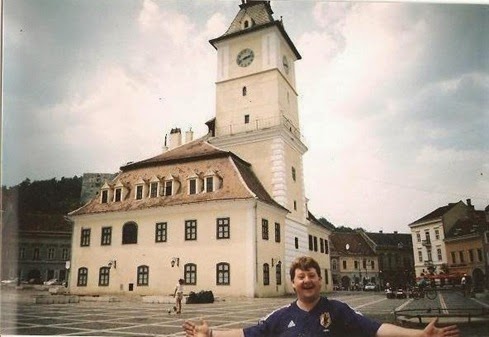
ML097 Braşov 2003, Romania or Germany?

But if Transylvania was very German and Wallachia far more Balkan, what of Moldavia, the third of Romania’s three major provinces. Was that different again and if so, in what ways? Was it perhaps more like Moldova which it used to be joined with or did it have more in common with the rest of Romania? In some ways it should have; they’re all part of one country for a reason and they unified for a reason, but conversely that unification is something that is still quite new: the three provinces only became one country as recently as 1918, (Wallachia and Moldavia united in 1859 with Transylvania finally joining after the end of World War I), so perhaps they still haven’t had time to blend together properly?

Whatever the case, my first impressions of Iaşi were of a country and a city very different to the ones that I’d left behind that morning. They may share a language and a name but 2012 Romania is noticeably richer – and thus smarter – than Chişinǎu, (or Tiraspol, Bender or the Ukrainian towns and cities that I’d visited). More than that though, to me it had a totally different atmosphere. Those cities had all worn their former communist status on their sleeves with concrete everywhere and Lenin statues in each park, yet in Iaşi one could be forgiven for thinking that socialism had never reached those parts. With ornate, bygone era buildings and higgledy-piggledy streets it was all very West European. Not Germanic though like Braşov and Sighişoara, but more like a French or Belgian provincial city. Not quite what I had expected at all.

After checking into my hotel, I set out to explore Romania’s second city. I headed first for Iaşi’s most famous landmark, its enormous Gothic Palace of Culture. On the way I saw a building which disturbed me immensely. It was a hideous concrete monstrosity but that wasn’t the problem. The sign on the front stated that it was the Peter Andre University. Now, I’m all for taking some things from the West, but dedicating a seat of learning to the man who inflicted the song ‘Mysterious Girl’ upon the earth! What on earth do they study there? Still, every cloud has a silver lining; we should be grateful at least that it doesn’t have a sister institution named after his ex-wife.

ML098 Peter Andre University: flavaly

Completed in 1923, the Palace of Culture was originally an Administrative Palace, a glorious Palace of Westminsteresque edifice for the new Romanian state built in its spiritual heart, the former capital of Ştefan cel Mare on the very site of his palace. The symbolism was unmistakable but these days its function is purely cultural , housing four museums. When I visited though everything was shut. Renovations they said. Bloody typical!

Across the road though, there was a museum that was open. The Museum of Old Moldavian Literature is housed in the 17th century house of the former Orthodox Metropolitan Dosoftei, the man responsible for printing the first church liturgy in Romanian in 1679. Despite not being able to read any of the literature on display there, (mostly Bibles to be fair), I found it all rather interesting. The house itself was very Ottoman in style, reinforcing the view that Romania is perhaps Balkan, whilst the works on display were in Arabic, Cyrillic and Roman scripts. Interestingly, I learnt that the Romanian language only started to be written in the Latin alphabet in the 19th century, before that it was usually in Cyrillic, which explains why it is the only Orthodox culture that does so, although that then begged the question as to why did they change alphabets in the first place? The answer to that I later learnt, was that it was all down to that old devil who so bewitches the Balkans with his black magic presented as goodness and light: Romantic Nationalism.
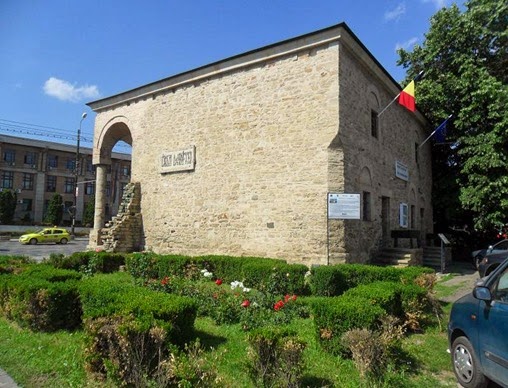
ML099 The Museum of Old Moldavian Literature

In the 18th and 19th centuries people began to look at languages and wonder how they came to be. Those early philologists soon picked up on the curious fact that the language spoken by the uneducated and uncultured, (in their eyes), Orthodox peasants in the villages of Moldavia, Transylvania and Wallachia was remarkably similar to that most educated and cultured (and Catholic) of all languages, Latin. Indeed, many considered it to be the closest of all the living languages to Latin. So how did this come about?

After a little digging around they found the answer: Dacia. The area now occupied by Romania was once a kingdom called Dacia which was defeated and occupied by the Romans in 106. It was clear what had happened: the Romans had settled there and mixed with the locals who had then adopted – and later preserved in the face of Slavic, Hungarian, Teutonic and Turkish onslaughts – their language. This idea was seized upon by nationalists who revelled in the fact that they were now no longer uncultured and uneducated peasants but instead Latins and thus ethnically and culturally superior to all the Slavs that surrounded them and the Hungarians, Germans and Roma who had settled in their lands. They started spelling their country’s name as ‘Romania’ to emphasise the Roman connection as opposed to ‘Rumania’ as it is pronounced and is spelt in Cyrillic, (and previously in English), whilst the labels Dacia and Dacian became ones of pride, (hence the name of the car company which has its factory in the town of Mioveni), whilst in line with all this Latinness, the script was increasingly written in Latin rather than Cyrillic letters so much so that in 1850 it was standardised and made official.

The Romans in Dacia theory is the one that is still held by most academics but in fact it struggles to hold up under scrutiny. The Romans were only in Dacia, a province right on the fringe of their vast empire, for a hundred and seventy-five years, (as a comparison, they were in Britain for around three hundred), and many of their soldiers were foreign who would not have spoken Latin as their first language. How come then they managed to alter the local tongue in a way which they did not manage in other places where their rule was much longer and in depth?

To answer this another theory has been put forward which I was told about the following day by Delia, the lady in the Iaşi Tourist Information Centre. The theory goes that rather than Romanian being derived from Latin, instead Latin is derived from Dacian which is a Pre-Latin language and was the original language of the tribe who, originating in Central Asia, dumped some people on the way in Dacia with a remnant continuing on to settle in Central Italy. Is this the truth instead? It certainly seems more plausible to me but then I’m no expert on the matter. We shall have to wait and see as it is seriously analysed in academic circles over the coming decades.[3]

After the Museum of Old Moldavian Literature I then headed to Iaşi’s other architectural gem, the Church of the Three Hierarchs, a 17th century edifice which is renowned for its intricate exterior carvings.

Except that it was covered with scaffolding and no intricate exterior carvings could be seen.

Ho hum. I went inside and it was nice, but overall I was annoyed. I’d really wanted to see this building as I’d read a lot about it and how its design was influenced by Armenian church architecture, (certainly its octagonal towers looked rather Armenian), but I had been thwarted.

ML100 The Church of the Three Hierarchs: nice towers, shame about the rest

Undeterred, I decided to press on in the same vein and explore some of the other religious sites of the city. Not being able to see the copy properly, I headed for the real thing, Iaşi’s Armenian Church which, built in 1395, is the oldest building in the city. That however, was shut so I walked on to the 1843 Bărboi Monastery which was mildly interesting and rather less crowded than the more central institutions. Whilst there I purchased candles as I always do in Orthodox churches but unlike in Moldova, Ukraine or indeed anywhere else that I’ve been, I could find nowhere to offer them. Confused, I asked the attendant who led me out of the church and round a corner to a greenhouse type building full of candles burning brightly for both the quick and the dead. It was the same in every church that I subsequently visited in Romania and although I never found out why they follow a different system to everywhere else in the world, my guess is that it has something to do with Health and Safety Legislation.
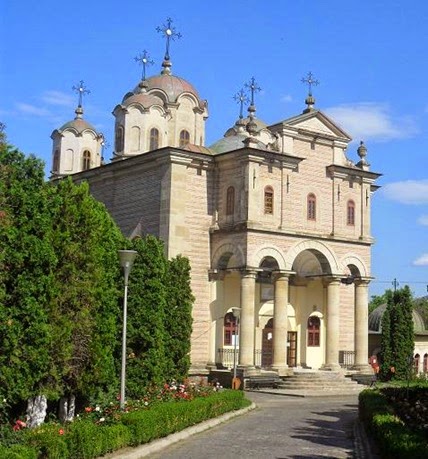
ML101 Bărboi Monastery (the domed building to the right houses the candles)

My final stop on this initial Iaşi exploration was the nearby 17th century monastery of Golia which is surrounded by a high wall and a tower which is quite spectacular and gives it the impression more of a mighty fortress than a place of prayer. The church inside was beautiful too, in the Moldavian style which I was now becoming accustomed to and I sat in prayer for some time there. After that though, what with the long journey earlier in the afternoon and all the walking in the sun, I was shattered so I retired to an internet café to reconnect with the world and then my hotel where I recuperated whilst watching the first game of the 2012 European Championships, a drab 1-1 draw between the co-hosts Poland and Greece. Then suitably refreshed, I headed out once again, to Piaţa Unirii for a couple of beers in a new country, watching the world go by in a city which I was beginning to like rather well.

Next part: Iasi (II)

My Flickr Album of this trip


[1] See my travelogue ‘Balkania’.

[2] See my travelogue ‘Slovakia and Hungary 2008’.

[3] If this subject is of interest to you, these two websites explain the theory well in English:

http://www.unilang.org/viewtopic.php?t=6171

http://www.dacia.org/carpatho-danubian-space.html