Sunday, 30 October 2011

Latvia, Georgia and Turkey Pt. 3: Tbilisi, Gori and Uplistsikhe


Part Three of my Summer 2010 trip


Links to all parts of this travelogue:

Part 1: Riga, Sigulda and Turaida

Part 2: Tbilisi, Mtskheta and Kazbegi

Part 3: Tbilisi, Gori and Uplistsikhe

Part 4: Batumi, Kars and Ani

Part 5: Doğubeyazit, Van and Diyarbakır

Part 6: Urfa, Haran and Adana

Part 7: Ankara and Istanbul


tbilisi map 2

29th July, 2010 – Kazbegi, Georgia
 
I woke around nine in time to catch the ten o’clock marshrutka back to Tbilisi. I was not unhappy to leave for although Kazbegi is incredibly beautiful, there’s not a grand deal to do there save hike and in the current heat, that was no fun. Furthermore, my homestay had proved disappointing compared with Tbilisi; the hosts were distant and the food, (bread, cheese and mashed-up egg washed down with lukewarm tea), the worst I was to encounter in Georgia. Still, it had been cheap at 20 lari per night plus 10 lari for the meal. Most of all though, I was aware of how much distance I had to cover before flying out of Istanbul on the 11th August and I wanted to get moving in the right direction. Back in Mtskheta I’d seen a sign showing Istanbul to be over a thousand kilometres away and that was by the most direct roads. By the route that I’d planned, I could count on almost doubling that figure – an awfully long way indeed.
 
The driver of this marshrutka was slower than the one up to Kazbegi, but as the vehicle was packed with people, it was no pleasure to travel in and by the time we got to Tbilisi I’d vowed to be travelling onwards to Gori by train. The problem when I got there though, was that at the Borjomi Station just down the road from Tbilisi’s central Station, I was informed that there was no train to Gori until 16:00, almost three hours away. To kill time I went back to Freedom Square for another free internet session in the tourist information centre before then checking out the restaurant next-door to the one that I’d dined at two days before. I chose pork mtsvadi; essentially a shashlik kebab, (I’d figured that once I hit Turkey pork would be unobtainable so best to get some whilst I could), but the meal was not as satisfying as the one at the neighbouring establishment although washed down with a bottle of the exquisite Kazbegi lemonade, (the most unexpected of Georgian delights), it filled a gap.
 
Returning to the Borjomi Station, I half thought that I’d stumbled into some West African town by accident as the whole platform was like a gigantic market crammed with people buying or selling or lugging huge bags around. A little confused I settled down by a concrete pillar to read some more of Fury and wait for the train.
 
When that train pulled in I was reminded of a scene from the 1965 version of Dr. Zhivago. The whole platform rose as one and surged towards the incoming train. Bags and babies were passed through windows and by the time I managed to scramble on board there were no seats left save for a solitary one on an aisle. Consequently, my journey was just as uncomfortable as my marshrutka trip earlier and I saw little of the passing scenery through the windows.
 
The day was lengthening as we pulled into Gori about an hour later. I’d seen little out of the window en route save a very arid and brown landscape. Nature however, was not my reason for stopping in that particular city for the night. Instead, I’d chosen Gori because it is the birthplace of Georgia’s most famous – or infamous- son.
 
Born Josef Vissarionovich Djugashvili on the 18th December, 1878 in a humble peasant shack in the city, the man who was later to adopt the name ‘Man of Steel’ – or in Russian, Stalin – rose to become the General Secretary of the Communist Party of the Soviet Union and the most powerful man on earth. Under the leadership of this humble Georgian, the USSR went from being an impoverished and backward state to a nuclear power which defeated the might of Hitler’s armies on the way. But such remarkable advances were achieved at a terrible human cost with millions perishing in catastrophic manmade famines or disappearing forever into the hell of the gulags – a vast network of prison camps where life expectancy was measured in months.
 
Alighting from the train I found a railway station that was grand and ornate and thus befitting of the hometown of the Soviet Union’s most influential citizen. A huge statue of the man himself graced the waiting room but beyond the foyer was just a humble square surrounded by nondescript buildings. I was reminded that Gori may be the birthplace of a famous dictator, but it is also a minor provincial city. Eager to see more, I hired a taxi – a Soviet-built Lada naturally – to take me into the heart of the city that bequeathed the Man of Steel to the world.
 
Now I have never made any secret of being left-leaning when it comes to politics and in my youth I was not far shy of a communist, (it was such sentiments that inspired my stay on an Israeli kibbutz which consequently developed into a love of travel), but my gusto for what is perhaps best termed as ‘Red Tourism’ is not really down to my political persuasions. I am very aware of all the evil that has been committed in the name of socialism over the world and of the fact that there is perhaps something inherent in the communist system that produces such evil. Nonetheless, all that aside, one has to admit that the Reds had a certain amount of style and none more so than Josef Vissarionovich Djugashvili with his wedding-cake skyscrapers, vast industrial plants, grand railway terminals and the stunning Cathedrals of the People metro stations in Moscow and the other great Soviet cities.[1] There is something indescribably appealing about it all, probably born from the fact that it is inspired by an ideology that’s bold about its future aspirations and vision. Democracies are cautious and uncertain by their very nature, but communist regimes are prepared to take a great leap forward towards a brighter future.[2] Of course, it didn’t always work, but, by God, the dream looked good! And so it is that I have long sought the holy places of the Socialist World – Red Square, Tiananmen Square, Ho Chi Minh’s Mauseleum, Enver Hoxha’s birthplace, the great dams and factories of the lands that once were – or still are – painted red. All that considered, you must surely understand why it was that I was so excited about the prospect of staying in Gori.
 
And I was not disappointed. Under the mastermind of Lavrenti Beria, another Georgian who headed the vicious NKVD, (Stalin’s secret police), and a man who is often considered to have been as bloodthirsty and merciless as Stalin himself, the town was rebuilt as a model socialist city and a shrine to the great leader that it had produced. Starting with the grand railway terminal, then an ornate bridge over the River Mtkhvari, then wide straight boulevards flanked by grand Italianate buildings in honey-coloured stone il finally, at the site of Stalin’s birthplace, the house in which he came into this world, carefully preserved and protected from the elements by a glass-roofed Doric temple, whilst behind the house stands the majestic Stalin Museum.


Gori: Stalin’s House (under the Doric temple) with the Stalin Museum behind and Comrade Pointon in front.
 
I checked into the Hotel Intourist, one of the grand stone edifices lining the city’s main drag, Stalin Prospekt. At 60 lari per night it was a little more than I’d wanted to pay, but as a true Red Tourist could I have stayed anywhere else but the establishment built by the socialist state to cater for socialist pilgrims to the Man of Steel’s birthplace? And besides, there were few other places to choose from and it was a rather grand hotel, with a huge entrance hall and a staircase worthy of a stately home, whilst my room was huge, with a high ceiling, en suite bathroom and two balconies which I then proceeded to hang out all my washing on.
 
After hanging out all my socks and pants, I made my way downstairs and took a stroll around the town, heading first to Stalin’s birthplace and the museum (closed) with a quick look at the great man’s railway carriage, (he was afraid of flying and so travelled everywhere by train; a laudable trait shared with fellow communist bogeyman, North Korea’s Kim Jong Il), before then heading down Stalin Prospekt to Stalin Square, the heart of the city.
 
During the 2008 War pictures of this square were beamed all over the world as the Russian Army rolled in and occupied the city as a “security measure” to “protect” South Ossetia which had declared itself independent of Georgia. Stalin Square with its grand provincial assembly building with glass dome and the 17m high statue of Stalin – the last surviving one of what were once thousands across the USSR – in its centre had been quite distinctive and I wanted to check it out first-hand, but to my dismay when I got there I found that the statue had gone. I later learnt that it was to be re-erected in front of Stalin’s birthplace, but for a while I wondered if the departing Russian troops had not stolen the monument to their former leader.
 
After Stalin Square I wandered along Chavchavdze Street and then through the winding alleys and ramshackle houses of the old city, (where Stalin had lived had been similar in character before they’d bulldozed and remodelled it all), and up the hill to the Gori-Tsikhe Citadel.
 
The citadel was open and no one asked for money so I wandered on in and had a look around. It was reasonably well-preserved but with no explanations to hand I learnt very little but I didn’t mind since my main reason in climbing the hill had been to sample the magnificent views available from the ramparts. One could see out in all directions – to the Mtkhvari River and the railway line beyond along which an incredibly long oil train rumbled its way, to the barren hills, to the city’s suburbs and then north to the breakaway republic of South Ossetia and the sheer white wall of the High Caucasus beyond.
 
South Ossetia is a place that interests me because one hears so very little about it. I later asked if buses ran there only to be told that the border is now firmly closed. Not many people outside of Georgia ever talk about the 2008 War fought between Georgia and Russia and in which the Georgian provinces of Abkhazia and South Ossetia broke away and declared their independence.[3] These two countries are now completely free of Georgia, (and indeed, have severed all ties), even if they are not so unencumbered by Russia, but few outside the region have taken any notice of them and of those that do, it is always the larger and richer Abkhazia that is discussed and rarely South Ossetia even though she paid a much heavier toll in the war.
 
Yet this little mountain republic is a fascinating place. With a population of only seventy thousand one might wonder how it expects to survive as an independent state when North Ossetia is part of Russia, yet the men in Tskhinvali, (the capital which lies less than 30km away from Gori), evidently mean business for when their powerful Russian neighbours and liberators invited them into the Russian Federation and union with North Ossetia, they bravely declined.
 
On a hillside to the north-east of the city I saw a strange development of brand-new square dwelling surrounded by a high fence. I suspected, (and this was later confirmed by research on the internet), that this was a settlement built to house ethnic Georgian refugees from South Ossetia who had fled from the Russian invasion and now had no homes to return to.
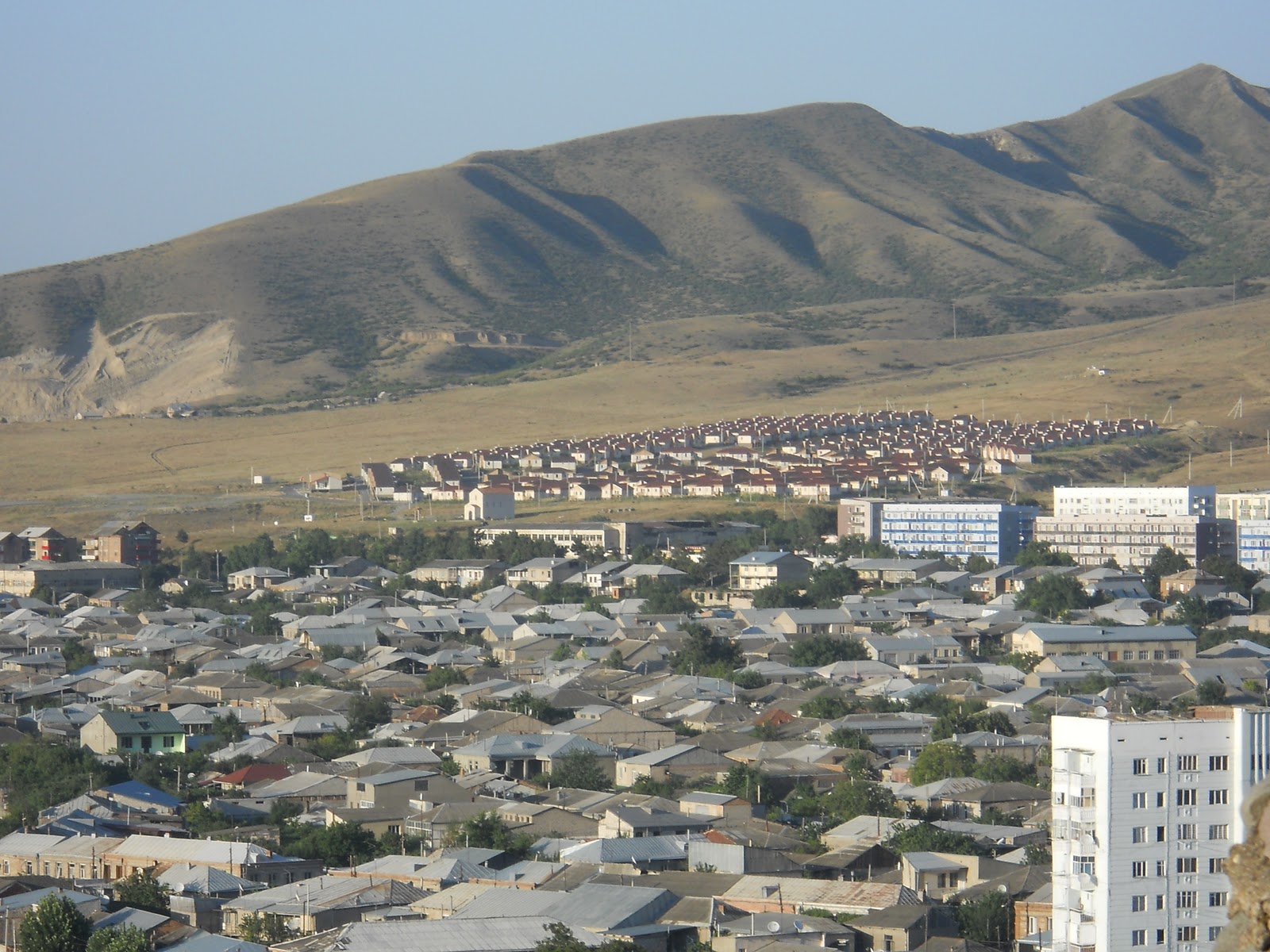
 
IDP (Internally Displaced Persons) Camp on the outskirts of Gori, built to house refugees from the 2008 War
 
I walked back down from the citadel and investigated a weird yet striking sculpture at the foot of the hill. It consisted of eight mediaeval knights cast in metal and twice life-size, sat in a circle as if discussing some important matter. However, each of the figures was missing something: a hand, an arm, a leg, even a head. What did it all mean? I suspect perhaps some episode from Georgian national mythology although it may have just been the product of some over-active imagination. Whatever the case, I was curious to know more.
 
The strange knights of Gori Citadel
 
 
By this time it was dark and I had worked up an appetite, so I returned to the Hotel Intourist and paid a visit to the hotel’s incredible restaurant complete with marble walls and glass chandeliers. I was though, the only diner, but I ordered nonetheless and enjoyed a fine meal of chakapuli, a lamb stew that was excellent, washed down with an equally palatable Kazbegi lemonade.
 
The restaurant at the Hotel Intourist, Gori
 
Then I returned to Stalin Prospekt where the locals were all enjoying their evening promenade, a custom as popular in Georgia as it is across the Black Sea in the Balkans.[4] In the small park in the middle of the street I met with a group of fellow tourists – the first I’d seen since Kazbegi – who all hailed from Israel and were looking for a room for the night. I couldn’t help them much as the Hotel Intourist was far more expensive than they were prepared to pay, but we had a short chat before moving on. Georgia sees very few foreign tourists but virtually all that I’d come across were either Polish or Israeli.[5] I wondered whether the tolerance that I’d learnt about in the synagogue in Tbilisi had a part to play in the Israelis’ choice of travel destination or whether it is more due to the fact that Georgia is one of the few countries in the region that will actually talk to Israel.
 
I settled down in a street café and watched the world go by. As the locals ambled by and the streetlamps shone in a long straight line to the birthplace of the city’s No. 1 son, I realised that I liked Gori in particular, and Georgia in general, very much.


30th July, 2010 – Gori, Georgia
 
Pilgrimage. That was the word that came to my mind as I walked around the Stalin Museum. The displays were reverential and the atmosphere hushed. Items from his youth and gifts from other world leaders were displayed as if holy relics whilst all the pictures on the walls showed the great man as benign, determined, strong and at one with children, but not once a tyrant. Add a beard and take away the sixty million (unmentioned) deaths and it could have been Jesus.
 
Things came to a head in the final room which was low lit and black save for a large, fanced-off red circle in the centre in which, laid in state, was a bronze bust of the man himself. I almost felt like bending down on one knee and prostrating myself to His Holy Image, shedding tears at the realisation that such a great human being had been taken from us.
 
And it continued outside. The guide who showed me round His armour-plated railway carriage and humble worker’s home spoke warmly and with affection about her hero whilst pointing out the personal items that had been lovingly laid out for view.
 
I left feeling strange. I have been on several Christian pilgrimages and I knew that feeling, except that this was different, it was somehow wrong. All the way through the museum, carriage and house, one could not help but remember the cost of it all. In amongst all the reverence, there was something missing, a story untold, a bad taste in my mouth.
 
It was interesting though. The fact is that the USSR, the atheist state, recognised that it people needed a religion and so they created one, the dual cult of Lenin and Stalin. Adulation such as was previously reserved for religious figures was heaped onto the two leaders such as here in the 1944 version of the national anthem:
 
Through tempests the sunrays of freedom have cheered us,
Along the new path where great Lenin did lead.
Be true to the people, thus Stalin has reared us,
Inspired us to labour and valorous deed![6]           
 
And in such cults the birthplaces of those holy figures become centres of pilgrimage and so it was with Gori both during Stalin’s life and after his death in 1953. However, after Khrushchev’s Secret Speech in 1956 where Stalin and his personality cult were denounced, the status of the museum town and its pilgrimage sites became a little unclear. Although kept up by the Georgians who were still proud of their son who had come to dominate world politics, (after the Secret Speech there were protest riots in Tbilisi in which hundreds were killed), the site no longer received any official recognition. And so it is today, Gori, a showcase and monument to a leader who is no longer revered, even amongst many Georgians, an embarrassment in some respects, yet at the same time an important historical monument and valuable tourist draw card in others. The man himself would not have been impressed.
 
 
Stalin’s statue by Stalin’s house
Stalin’s armour-plated railway carriage
 
I took a taxi to the railway station in time to catch the train onwards to Borjomi, but upon arrival found that I’d read the timetable wrong and there was no train to that place until five which threw my plans out a bit. My other option was to catch the night sleeper to Batumi which, although it meant missing out on some potentially interesting places, was more realistic considering my tight schedule, so I booked onto that instead and then finished off Fury. That left me with a problem though, for I now had almost twelve hours to kill before the train so, reluctantly as I didn’t really want to spend the money, I hired a taxi to take me out to Uplistsikhe.
 
Uplistsikhe is some 10km from Gori through some interesting villages with fascinating decaying examples of Soviet public housing. It was once a major city on the Silk Road, a trading centre by at least the 5th century BC and although it diminished in importance as the years passed, it was not destroyed until the 13th century when Genghis Khan’s son Khulagu came to town. All of this alone makes the site worth a look, but what is more interesting is that it was built entirely out of caves hewn into the cliffs. Whilst my guidebook warned that there has been much  erosion, conversely a lot still remains and I spent an enjoyable three hours clambering about, investigating the different caves, wondering at the strange round holes in the floors of many, (I later learnt that they were once ovens), nearly falling over sheer precipices which would send any Health & Safety Manager mad and marvelling at the impressive views out over the arid Mtkvari Valley with Gori in the distance whilst in the foreground the remains of a village whose inhabitants were removed by the government in 1968, one presumes to helpt reduce the amount of damage they were doing to the World Heritage Site next door. I hadn’t, in truth, expected much from Uplistsikhe; archaeological sites of that nature often tend to be undecipherable to the layman, but this had not been and in addition it was fun. More than that though, it made me realise that in many respects this trip was going to be an extension of my great 2002 expedition.[7] Then, the Lowlander and I had traced the Silk Road from China all the way to Uzbekistan before we’d veered off north up to Moscow. Now though, I was picking up the road again, a mere 800 miles further on from where I’d left it, (small fry in Silk Road terms), across the Caspian Sea and I would continue on it to the very gates of Europe. Like Bukhara, Samarkand, Urumqi, Jiayuguan, Lanzhou and Beijing, here was another great Silk Road city and I knew as I gazed west that I’d be seeing several more before this trip was out.
 
In one of the caves of Uplistsikhe
 
After exploring Uplistsikhe I was hot and tired, so I had the taxi return me to the railway station where I read some of Kim Philby’s autobiography My Silent War which I’d started the previous evening and wrote a little of my travelogue until the sun started to sink in the sky and my stomach started to rumble. Then I took a stroll back into Gori, over the ornate Stalinist bridge and up Stalin Prospekt until I spied an establishment named ‘Hunter’ which was very interestingly decorated, (for that read very east European cheesy), and specialised (unsurprisingly) in meat that has been hunted. This time I tried kharcho, (a spicy soup of mutton, garlic, rice and vegetables), and khinkali, (pasta envelopes of dough stuffed with mincemeat). I then strolled around the town looking for an internet café which, when I eventually found one near to the university, was strangely full of pre-teen boys speaking Greek. What on earth were they doing there? They looked too young to be on a student exchange and seemed to be at home in the establishment so were they locals? Georgian has a small Greek-speaking population but most of them live on the Black Sea Coast or in Lower Kartli (i.e. south of Tbilisi near to Armenia), so why an internet café full of Greeks in Gori? One of life’s little mysteries I suppose…
 
I strolled back to the railway station to find the young English-speaking station master there who had booked me my ticket on the sleeper and helped me get a taxi to Uplistsikhe. He invited me into his office and we shared my Kazbegi lemonade and there in the railway station in Stalin’s home town, I continued with my induction into Georgian society and culture.
 
Giorgi Javakhishvili was a young man in his twenties who had recently graduated from university in Tbilisi. He was not happy with the paltry salary that he earned as a station master, but he also appreciated that he was lucky to have a job in 2010 Georgia. He told me that he personally did not have the highest opinion of Stalin although he did respect him as a strongman. As regards to the country’s current president, Mikheil Saakashvili, like all other Georgians that I spoke to, he did not blame him for the 2008 War as most foreign observers did. No, that was all Russia’s fault, they were the instigators, they stole Georgian territory, at least Saakashvili fought back although the loss of both South Ossetia and Abkhazia was hard to bear. But what of Gori itself, occupied by the Russians during the war? Yes, it was hard, but we just kept our heads down, it wasn’t for so long and they didn’t destroy too many buildings.
 
Giorgi was also, like all Georgians, very religious and very cultured. He recommended I read Rustaveli, the famous mediaeval Georgian poet and in particular his work ‘Vepkhistkaosani’. The only atypical feature about my jovial host was that he was not yet married. There is a girl, yes, but I don’t have enough money to get married yet. Also, she is still studying. One day soon, I hope…
 
The four hours until the train arrived passed quickly and as I boarded the night sleeper to Batumi, I was waved off on my journey by yet another Georgian who had justified his country’s reputation of providing extremely warm welcomes.
 
Me with Giorgi Javakhishvili, the friendly station master at Gori


[1] Although not Tbilisi whose metro system was built much later and is, alas, quite bland. See ‘Across Asia with a Lowlander’ for my thoughts on the Moscow and Tashkent systems.
[2] The same too, it must be said, with fascist regimes. See my comments on the Olympic Stadium in Berlin on page 23 of ‘Travels at the start of 2007’.
[3] To this date however, only four countries have recognised the two breakaway republics as independent countries. Aside from Russia, these are Venezuela, Nicaragua and Nauru. It seems that the declaration of Kosovan independence was the inspiration behind the move but without Western backers (like Kosovo has) international recognition was always going to be unlikely.
[4] See ‘Albanian Excursions’ p. 48
[5] I’d been mistakenly assumed to be Polish on several occasions with my white skin and execrable Russian.
[6] Calendar 1917-1947: Thirty Years of the Soviet State, frontspiece
[7] See ‘Across Asia with a Lowlander’

Saturday, 29 October 2011

Latvia, Georgia and Turkey Pt. 2: Tbilisi, Mtskheta and Kazbegi


Part Two of my Summer 2010 trip


Links to all parts of this travelogue:

Part 1: Riga, Sigulda and Turaida

Part 2: Tbilisi, Mtskheta and Kazbegi

Part 3: Tbilisi, Gori and Uplistsikhe

Part 4: Batumi, Kars and Ani

Part 5: Doğubeyazit, Van and Diyarbakır

Part 6: Urfa, Haran and Adana

Part 7: Ankara and Istanbul

tbilisi map 2

26th July, 2010 – Tbilisi, Georgia
 
It was dark when I arrived in Tbilisi. There was a funky new railway station (it looks like a giant golden snail!) at the end of the new rail extension to the airport, but no train into the city until 07:20, more than two hours away, so I settled down and continued to read Fury, a hefty novel all about the Holocaust, Jews and Arabs in 1930s Palestine culminating in a showdown during the 1948. I’d started it on the plane to Riga and it was easy reading for a tired man and before I knew it, the Soviets were bombing Auschwitz and my train to the city had arrived.
 
My first impression of Georgia was not a positive one. On a wall by the trackside someone had scrawled ‘BACK’S TREAT BOYS’. What was worse; the punctuation, the spelling or the taste in music? No, this did not auger well for the Georgians! The other things I could see from the dirty carriage window were none too positive either. A lot of rusty wagons, dilapidated apartment blocks and abandoned factories surrounded by twisted metal and chunks of concrete. The place looked like it had just been through a war. It was only later that I remembered that it just had.
 
I hailed a taxi outside the Central Station and asked the driver to find me a reasonably-priced place to stay. He recommended a dom (homestay – literally ‘home’), rather than a hotel stating that it was cheaper. Always up for saving money I agreed, and we chatted, him praising me on my (excreable) Russian.
 
The homestay proved satisfactory, all be it a little more than I wanted to pay at 50 lari per night, but I was tired and didn’t care. It was a strange place, only minutes from the railway station but like a village house, gerry built with a balcony covered in vines. Whatever, I didn’t care; a bed is a bed and I lay down and caught up on some of my lost night’s sleep.
 
Upon waking I felt dirty and tousled, but I knew the answer to that one. My guidebook informed me that the name Tbilisi derives from ‘tbili’ which means ‘warm’, a reference to thirty hot springs that have provided decent bathing for the locals for millennia. So, off I went on the metro to the old part of town to book myself in for a nice warm thermal bath.
 
At first though I couldn’t find the Abanos kucha (Street of Baths). I exied the metro at Avlabari then crossed the Mtkvari River, making for the Armenian church which was near to the baths, but then I got lost and ended up climbing up to the Narikala Citadel which afforded spectacular views across the city, (and down to the bath houses which I could now work out how to get to!), but was a bit of a disappointment as a castle and the priest would not let me into the church due to my shorts, (although they’d been no problem in the Armenian church but a few minutes earlier).


Tbilisi panorama from the Narikala Citadel
 
The first baths that I went into wanted a whopping 60 lari (£20) for an hour’s session. The second – the Sulphur Baths – wanted 30 lari. It was still more than I’d anticipated or wanted to pay, but I really did need a bath and occasionally I will splash out,[1] so I booked a cabin for an hour. The Sulphur Baths were not the best bathing that I’d ever encountered with only a hot bath, no cold shower and the massage only passable, but they were quite atmospheric and most importantly, by the end I felt clean and very refreshed.
 
Revitalised, I embarked upon a walking tour of the highlights of Tbilisi. I strolled through the Kala District, the old city whose twisting streets climb up the hillside on the left-hand bank of the Mtkvari River. I stopped at the synagogue where I was invited inside by an old man who proceeded to tell me all about Tbilisi’s Jewish community, firstly in Russian and then, when he discovered my nationality, in near perfect English. Apparently, there are about two thousand five hundred Jews in the city today, (and around five thousand in the whole of Georgia); there used to be many more but most have emigrated to Israel. He himself had been to Israel and lived in Beersheva for some months and he was delighted when I told him that I’d once lived and worked on a kibbutz only a few miles from that city. I asked why so many had emigrated and he explained that it was due solely to money, not anti-Semitism. “I can say that anti-Semitism does not exist in Georgia,” he said proudly, “and it never has done. This is a tolerant country.” Now, if only more countries could honestly boast the same thing.
 
Tbilisi Synagogue and its friendly caretaker
 
Tbilisi, I was fast discovering, is a strange city, unlike any other that I have ever visited. In parts, (around the railway station and the Avlabari Metro Station), it is positively Third World; chaotic and crumbling, whilst in other areas such as the Kala District it is a hive of repairing and rebuilding, its aged buildings neither European nor Asian. Most of all, it is unlike any other Socialist city that I’ve visited, disordered, its streets veering off all over the place, its buildings all of a jumble, like one super-sized village that hasn’t yet realised it’s a metropolis. There’s some stunning architecture too; old houses with wooden balconies that look like something from the American Deep South, Moorish extravaganzas like the opera house and Stalinist masterpieces like the Parliament Building and Academy of Sciences. All in all, it was a place that I liked but found somehow hard to comprehend and get to grips with.
 
After the Kala District I walked to
Freedom Square
with its stunning statue of St. George (Georgia’s patron saint, hence the red crosses on a white background on the flag, just like England) which Lenin used to stand. Then I headed along
Rustaveli Avenue
, the Champs d’Elysses of Georgia where the ministries and cultural buildings are situated until I reached the Rustaveli Metro Station, by which time I was shattered and could walk no more, so I returned to my homestay, stopping off at a grocery store en route. Then, after a rest, I dined on sausage and cheese before enjoying a beer on the balcony and reading a bit more of Fury.
 
My host came up to chat with me and informed me that her son was an architect who designed churches whilst her husband was an artist who’d attained some fame in Soviet times. I told her about my brother and she showed me into her husband’s studio which was full of paintings of quite a reasonable standard indeed.
 
I then decided to ask her husband about using the internet, (he’d offered it earlier), but he informed me that his son, (who understood how to use computers), was absent but that I should have a beer with him instead. So it was that he took me to his garage, (which doubled up as a bar), and I was bought a glass of Kazbegi, the local lager. The presence of a new face however, was greatly appreciated by the locals and soon the one beer became two, then three, then four, and I was being given a truly Georgian welcome from an out-of-work economist who spoke excellent English, a builder, the archetypical local drunkard who was called Shalva and who did some kind of manual work for a living and ‘The Major’ who had been a major in the Georgian Infantry prior to his retirement and current occupation of drinking in the garage. So it was that I drank away my first night in Georgia talking football, religion, politics and history until I stumbled upstairs to bed.


27th July, 2010 – Tbilisi, Georgia
 
The landlady at my homestay had told me that if I waited at the bus stop near to the house, then bus No. 150 would take me to Mtskheta, the Vatican of the Georgians, which lies some ten kilometres or so north of Tbilisi, but after waiting for an indeterminately long time no such bus came so I gave up and took the metro instead to the Didube Bus Terminal where my guidebook informed me that marshrutkas (Ford Transit minibuses that seem to be the main mode of public transportation in Georgia) depart regularly to more or less anywhere in the country.
 
Of all the places that I went to in Georgia, nowhere seemed more Asiatic and developing worldly than the Didube Bus ‘Terminal’. Leave the crumbling concrete metro station (very 1984), go through the underpass full of beggars and hawkers selling all manner of junk from knives to Chinese toys, cheap clothing to cheese, religious icons to CDs of Georgian folk music, then you enter a vast unpaved yard surrounded by tin shacks selling more junk, lined on one side by a rusting, half-built metal barn whilst in the middle scores of marshrutkas with cracked windscreens were dumped. It is more Kabul than Kiev.
 
The trip to Mtskheta was not a long one, through Tbilisi’s very Soviet suburbs and then the open road. What I’d expected to be a suburb of the capital was in fact very much its own place with a little square in the centre where the marshrutka dumped me. There was a chemist’s on one side and a dilapidated public building on the other with a museum at the end. I tried the museum first but it was disappointing as it was under renovation and so most of the exhibits were locked away and the ones that remained unimpressive and so, after having perused some cracked pots and spear heads labelled in Georgian, I took at look at the public building which may have been a town hall once but now had all its windows smashed. What grabbed my eye though was a magnificent communist-era mosaic across the top which depicted Mtskheta’s history. Many people criticise the style of art under the Soviets, but I rather like it and this was a fine example indeed.
 
Mtskheta mural
 
The mural thus examined, I went on to the real business of the day; the Cathedral of St. Tskhoveli, which is the reason why most people come to Mtskheta.
 
The cathedral is built on the site of the palace of the kings of Iveria, the Georgian state at the time of the Greeks and Romans, and the present church dates from the 11th century. It’s the Canterbury or Vatican of the Georgians and I knew from the moment that I entered its walled compound that I was somewhere very holy. The church was a truly incredible building; its raw stone giving it an earthy, natural feel whilst the colourful Georgians frescos gave it life and vitality, (unlike the generally morbid blacks and golds of the other orthodox denominations). My favourite part however, was a replica of the tomb of the Holy Sepulchre in Jerusalem, made for pilgrims who are unable to make the pilgrimage to the Holy City. I wandered around for ages, taking in the atmosphere, watching the pilgrims prostrating themselves before the altar and generally getting a taste of the intense spirituality and religiosity of the Georgian people. All in all, it was one of the most moving religious buildings that I’ve ever set foot inside and the short trip out from the capital had been truly worth the effort.
 
Me and the Cathedral of St. Tskhoveli
 
Before returning to Tbilisi, I also had a look around the 11th century church at the Samtavro Nunnery which stands on the site of the very first church in Georgia. Whilst it was pleasant, it didn’t really compare with the cathedral although the tiny 4th century chapel built in the grounds was moving. That was built on the site of St. Nino’s hut which, in terms of religious significance, must make it the most important Christian site in all of Georgia. Although the patron saint of Georgia is St. George, St. Nino is also widely revered and with good reason too, for it was she who brought the faith to the Georgians. Nino was a Cappodachian slave who possessed the gift of healing and after she cured Queen Nana, the queen converted to Christianity. She was soon followed by her husband, King Mirian, who was impressed when Nino destroyed some pagan idols with a thunderbolt and caused an eclipse of the sun. The tombs of those illustrious monarchs are to be found in the nunnery’s church and it is due to the combined efforts of those three that Georgia became only the second country in the world to officially adopt Christianity in 337AD, only thirty-six years after the neighbouring Armenians had chosen the same path.
 
St. Nino’s Chapel
 
Back in Tbilisi I decided to look for somewhere to eat so I took a metro to Freedom Square thinking that there should be plenty of places to eat around there. In the city hall I noticed a tourist information centre which I entered and learnt (to my dismay) that there were no buses running from Akhaltsikhe to Kars which was the route that I had planned to take into Turkey, but I also learnt (to my delight) that there were several cheap restaurants in the next street. Information obtained, I checked my email on the free computers there and overheard one very annoying Australian tourist ask the poor girl behind the desk questions about ferries that she couldn’t answer and when he could not get what he wanted, he retorted “Look, you’re a tourist information centre and I’m a tourist and need some information so get it for me!” I felt like going over to him and reminding him that this was not the First World and if he wanted travel with easy answers, he should have taken the backpacker bus around Ireland like so many of his compatriots do![2]
 
The restaurant recommended by the tourist information centre turned out to be both cheap and marvellous. I tried the Georgian specialities kharcho (mutton soup with garlic rice and vegetables – the same consistency as curry) and mtsvadi (pieces of chicken wrapped up in bacon served in a spicy sauce – again, almost curry consistency). Delicious!
 
Full up, I decided to go for a short walk to burn off all those newly-acquired calories. Looking at the map I wondered about heading for the Pantheon – some sort of Georgian National Shrine – on the hillside above the city centre and below Mtatsminda, the large hill that dominates the town. On the way I passed the Museum of Money and being a collector of banknotes, I popped in only to be greeted by an extremely enthusiastic curator who was also a devotee of paper money and who proceeded to give me a personal guided tour before presenting me with an official guidebook for free as I left.
 
My quest to reach the Pantheon however, was far less successful. After tiring myself out climbing innumerable steep streets, the nearest O got was the base station for the communist era cliff railway that led up to Stalin Park on Mtatsminda. There were signs of recent renovations to the station (and Stalin Park was reported to be open again, albeit under a new name), but that was for the future, not now and the trains were not operating when I tried to catch one. Defeated and bitter, I ignored the attentions of a waiting taxi driver and trudged back down those steep streets to the metro.
 
After relaxing and reading for a couple of hours in my room, I wondered about making good on promises made to the local drinking community the night before in the garage bar. To tell the truth, I wasn’t really in the mood for drinking again, but a man’s word is his bond and I had a feeling that the Georgians would be the kind of people who set great store in promises and besides, one often prays for a welcome in a strange country and thus one shouldn’t begrudge it when it’s offered, so I made my way down the stairs to the garage.
 
The first glass of Kazbegi deposited in my rotund, designed-for-beer stomach and all my second thoughts about having a night on the ales were banished and I got caught up in the great Georgian craic once again. The crowd differed slightly from the night before – the Major was nowhere to be seen and in his place was a man who looked like a Mexican bandit and acted just as crazily. “He’s a little mad, but he’s a good man really,” explained the English-speaking economist. “It’s just that he loves Abkhazia too much. He took a bullet in the head in Sukhumi and he’s not been the same since.” Bandito grinned wildly and made a shooting gesture at his own cranium so as to reinforce the point. I could think of nothing to say in reply.
 
We got talking of religion and the Armenians. I’d mistakenly praised Georgia for being the second country in the world to adopt Christianity (after Armenia) to which vociferous protests told me that they were the first as the Armenians were not true (i.e. Orthodox) Christians and besides, they were sure that the Georgians had adopted the faith first. There were discussions about the Trinity, (which the monophysist Armenians do not accept), and the Georgian method of genuflexion which is a very particular art, full of symbolism, unlike the almost casual Catholic way of crossing oneself.
 
Moving onto the Armenians in general, my Georgian drinking comrades stated that although it was terrible what had happened to them in the past, (i.e. the 1915 Genocide), they were a difficult people to get on with who loved to complain and were obsessed with making money, unlike the Georgians who liked only to have a good time and fight for their land.
 
As the evening drew to a close, I redemmed myself from my earlier remark by proposing a toast that we meet again soon, and that when we do, both Abkhazia and South Ossetia will be Georgian again. Such rhetoric delighted my hosts and the toast was taken up more enthusiastically than any other I have partaken in.
 
Drinking in the garage. Left to right: Me, forgotten his name, the unemployed economist
 
Drinking in the garage. Left to right: Me, forgotten his name, Shalva who is originally from Borjomi, the Man Who Loves Abkhazia Too Much; the local builder


28th July, 2010 – Tbilisi, Georgia
 
Early the next morning I headed back to the Third World chaos of the Didube bus station where I boarded a battered marshrutka – sporting a windscreen cracked right across the middle – for the mountain town of Stepantsminda, (or ‘Kazbegi’ as it is unofficially called).
 
It’s not often that I visit somewhere purely because it looks nice; normally sites of cultural, religious or political significance interest me far more, but one look at a picture of the church of Tsminda Sameba at Kazbegi in the guidebook convinced me immediately that this was a place worth making a detour of around a hundred miles each way for. The town sits high in the Caucasus Mountains in the shadow of Mt. Kazbek, Georgia’s most famous and recognisable peak even if she is not the highest. Still, at 5,047m she is no mean mount, beating any other mountain in Europe outside of the Caucasus.[3] In between the mountain and the town, perched atop a much lesser peak although still a very respectable 2,170m above sea level, is the Tsminda Sameba (Holy Trinity) Church, a 14th century beautifully-proportioned building that, with the snow-capped Mt. Kazbek in the background, is an unofficial symbol of the Georgian state.
 
That it looked incredibly beautiful was my main motivation, but not the only one for I’d also realised that the route through Georgia to Turkey that I’d planned to take was down the valleys and so I’d be missing out entirely on the grand Caucasus Mountains which, after all, are the main attraction of the region. So it was, I considered, that a side-trip up to Kazbegi would be worthwhile, if only to get a taster of one of the highest mountain ranges on earth.
 
The marshrutka started off at a terrific speed, its driver obviously eager to break the land speed record on his way to Kazbegi. Although not noted for dawdling when behind the wheel myself and not easily shocked by developing world driving, this guy scared me, especially since the only time he took his foot off the pedal was to genuflect at a church whizzing past his windows. Still, what it did make for was a speedy trip and the driving time up to the Roof of Europe was only three hours and that included a thirty minute break!
 
Outside of Tbilisi, the landscape was uninspiring with ancient churches providing the main points of interest, but after about 30km we passed by the Zhinvali Dam and Reservoir. Big dams rather interest me[4] and this one was both quite an impressive one and quite a late one by Soviet standards, being completed only in 1986 and helping to supply Tbilisi with much of her power and water supply. At the dam head there is a huge and rather strange monument to celebrate the event which consists of an enormous slab of concrete with figures embossed on it and a haircut of enormous steel spikes.
 
Monument at the head of the Zhinvali Dam
 
The reservoir behind the dam is equally impressive. Around 10km long, it has two arms along the valleys of both the White Agravi and the Pshavis Agravi rivers and it’s incredibly beautiful, reminding me of similar bodies of water that I’d seen in Albania the year before.
 
The road that we were travelling along is noteworthy in its own right. Its English name is the
Georgian Military Highway
and it was built as a carriage road back in 1783 by the Imperial Russian Army although there has been a bridle track over the mountains since the 1st century BC. It took over eight hundred soldiers to construct it, but for the Russians it was undoubtedly worth it. They’d begun conquering the Caucasus in 1722 under Peter the Great and in 1769 the Russian General Todleben had crossed the High Caucasus to take both Tbilisi and Kutaisi off the Turks who held them at the time. The opening of a decent road helped them to keep hold of their acquisitions and to expand south in due time to Armenia and Azerbaijan. The Russians were not unwelcome either at the time, for the Georgian kings saw them as fellow Christians come to deliver them from the rule of the Muslims, although in years to come many regretted the building of the road for it thwarted several Georgian rebellions against Russian domination, from the 1846 insurgency by Shamyl to the 2008 war when the Russians poured south through Ossetia and down the Military Highway to take Gori and several other towns in the Georgian heartland.
 
After the Zhinvali Reservoir, the road began to climb steeply, passing through gorgeous mountain scenery, the like of which can be matched by few places on earth. At Zemo Mleti we stopped for drinks and I bought a traditional Georgian woollen hat, but then we climbed on further, twisting and turning up to the ski resort of Gudauri which, at 2,196m, was the highest point on the journey. Up here the road passed through many concrete tunnels, though these were in poor condition and often the traffic bypassed them on unmade tracks. One assumes that they must come into their own in the winter when the snow really piles up.
 
Here in the very High Caucasus, the settlements were few and most agriculture seemed to be goat herding. There were also some cattle, and strangely they always congregated on the road bridges causing Speedy Gonzalez to have to slow down, much to his consternation. Another point of interest were the mediaeval watchtowers that one sees occasionally in the region, built as protection against marauders and again, comparisons with Albania came to my mind as her northern mountains are dotted with similar towers.
 
Soon though, we reached the town of Kazbegi itself where the marshrutka was met by a lady enquiring if anyone wanted a dom. Pleased with my Tbilisi dom experience which had proved both comfortable and an introduction to the local drinking community, I accepted and followed her up a stony track to her home, a large house built in traditional style that commanded the finest view I have ever had the pleasure to view from a room for the night, looking up to the Tsminda Sameba Church and then the snow-capped Mt. Kazbek beyond. This however, was no time to sit around indoors and so after putting my bags down, I ventured out again to explore my surroundings.
 
A Room with a View, Kazbegi
 
Whilst Kazbegi turned out to be as stunningly beautiful as I’d hoped it would be, unfortunately it did not live up to my other expectation. Having been overwhelmed by the intense summer heat ever since stepping off the plane in Riga, I’d hoped that a small town some 1,797m above sea level might be a little cooler but, remarkably, Kazbegi was as blisteringly hot as Tbilisi had been. I looked across at the Tsminda Sameba Church and realised that my plan to hike up to it was just not going to happen, as I was still shattered from the walking done in Latvia and my hike around Tbilisi the day before and in this weather I knew I’d be wilting before the first kilometre was completed. Another way up there would have to be found, but that could wait; I would explore the delights of the town first.
 
Kazbegi is a place of some four thousand souls and was unlike almost anywhere else that I’ve ever been to. Her buildings reminded me a little of those in the Atlas Mountain villages in Morocco but there was still something positively Russian about it all. Like the rest of the Georgia, it was hard to place. Wherever it was, it was not rich. Aside from the main road through, all the streets were unmade and an air of languid lethargy hung over the town as if very little ever happened there. The main attractions for the tourist were the Museum of Alpinism (next-door to my homestay, closed), the parish church and the Kazbegi Museum. The former was a wonderful, evocative place, shaded by trees and with very pagan carvings of strange beasts and men on the exterior. According to my guidebook, religion in the mountains is still very pagan[5] and in this tiny sanctuary, I could believe it although at the same time such syncretism amidst a very forbidding nature seemed entirely correct.
 
The Kazbegi Museum next door to the church was far more interesting than I’d anticipated. Situated in the former home of one Alexander Kazbegi, a noble who became a poet and a shepherd and who was much loved for it. It was full of pictures of the great man and things that belonged to him. It reminded me very much of the ethnographic museums that litter the Balkans[6] as it had displays of traditional clothing and artefacts, but it was interesting and gave some cultural flesh to the area.
 
However, the real attraction was the church on the hill, so I went over to a tourist agency and booked a car (for more than I’d have liked to have paid) to take me up to the Tsminda Sameba Church.
 
The vehicle, when it arrived, was a UAZ-469, the Soviet equivalent of a jeep. At first I wondered if they’d tried to swindle me a little by making me book a far more expensive vehicle than what was required, (I’d expected a Lada), but within minutes of setting off it became clear that they’d provided the UAZ because nothing else would have made it up the road which was one of the most horrendous tracks that I’ve ever travelled along. Soon after crossing the River Tergi we passed through the village of Gergeti which reminded me of the pictures one sees of settlements in the Pakistani and Afghani Highlands with ancient stone houses and goat pens. Then we started climbing up the mountainside, zig-zagging through a forest. We passed several walkers and one group thumbed at us to stop. The driver enquired if I didn’t mind and since I did not, we picked them up and gave them a lift. They were Poles, two men and two women and although a lot fitter than I, they looked absolutely beat and I was glad once again that I had not attempted the hike.
 
We dropped the Poles off at a meadow just shy of the church where they intended to camp before continuing on alone. The UAZ driver waited whilst I went up to the sanctuary alone. Like its brother in the valley below, it was covered with very pagan carvings, but inside it was very atmospheric, again, like the cathedral at Mtskheta, exuding an aura of very earthy holiness, primitive yet profound. I stayed and prayed for some time in that dark temple before buying a leather amulet of St. Nino from the monk there to protect me on the rest of my long trip.
 
Outside I felt rejuvenated. The views were magnificent in all directions, up to Mt. Kazbek, down to the town; across to the meadow where the Poles were camping and over to the mountains that form the border with Chechnya and the rest of the Russian Federation. More than that though, here I had truly found what I’d been seeking since Riga, a cooler temperature! Whilst not cold, there was a fresh breeze blowing across the mountainside and it was bearable. I felt alive and I savoured it for a very long time before reluctantly getting back into the UAZ and returning to my homestay for the night. After all, I did not know when I would be able to enjoy such temperatures again…
 
Mt. Kazbek from the Tsminda Sameba Church. Note the tents of the Poles
 
Kazbegi town from the Tsminda Sameba Church. Beyond the mountains lies Chechenya


[1] Dreadful pun not intended.
[2] With stops at the Guinness Brewery and Blarney Stone. My friend Paul, who lives within walking distance of the Blarney Stone gets very exasperated about such things and has never once kissed it.
[3] That is if Mt. Kazbegi can be said to be in Europe. The national (and thus the continental) border runs through Mt. Kazbegi and so she may in fact, be Asian.
[4] See Albanian Excursions p28-9
[5] Bradt, Georgia, p.154
[6] See Albanian Excursions p.9