Monday, 6 May 2013

V-log 3: A Tour around Schouwen-Duiveland


Greetings!

Since you've been getting to know him quite well on the Across Asia With A Lowlander travelogue, I thought that it might be nice to teach you all a little more about this mysterious figure who is the Lowlander and, more importantly, what makes him who he is. So, back in 2000 I popped across to his island, Schouwen-Duiveland in the Dutch province of Zeeland, and here's the result; the Lowlander shows us his island, (albeit with a time-lapse of over a decade).


To be fair, home of a travelling companion or not, Schouwen-Duiveland is a place that I particularly love. There's a strange beauty to its perfect flatness, (it is mostly below sea-level), and its history - both modern and ancient - is fascinating. But then again, you'll find all that out for yourself as we visit Zierikzee, the Plompentoren, the Ooster-Schelder Dam and the enigmatic Domain where, try as we might, we just can't find the watchtower...


BTW, a quick warning, the sound quality is naff, I know, but I can't seem to improve it.

Keep travelling!

Uncle Travelling Matt

Check out all my V-logs!

Friday, 3 May 2013

Across Asia With A Lowlander: Part 2e: Yinchuan (I)

world-map yinchuan

Greetings!

Posting these old travelogues can sometimes lead to some interesting surprises. Rereading this and arranging it for the internet, I looked online for a suitable city map of Yinchuan to help readers orientate themselves. However, none of the maps I came across resembled anything like the Yinchuan I remember which was, as I have written below, two cities: the ancient one and the modern one founded in the 1950s around the railway station and some several kilometres from its older brother. On all the maps though, it appears as one, with the railway station in its heart.

Confused, I decided to research further and so went on Google Earth and the mystery was revealed. In the intervening 11 years between visiting the place and posting it on UTM, Yinchuan seems to have grown beyond all belief and the two cities are now one. The railway station is still where it was, but the square at the front entrance which I describe is now the back exit and instead a huge new station has been built on the other side of the tracks, (facing the old city). Where once were single track roads are now expressways and Haibao Ta Pagoda which I describe as being “on the edge of town” is now surrounded by a sea of development; a world away from the green fields in the photographs that I took. In this travelogue I write a lot about the pace of change in China and nowhere has that been more evident that the quiet city in the desert which you can read about in this week’s extract.

Also of interest is something which I definitely knew nothing about during my visit over a decade before; an intriguing site some 35km or so to the west of Yinchuan. The Huangyantan Military Base is, unsurprisingly, off limits to tourists, but ever since Google Earth scanned the area a few years back, it’s been the subject of much attention and debate outside of the People’s Republic. According to the People’s Liberation Army, it’s merely part of a tank training base built between 1998-9, but the 900m by 700m top secret compound is actually an exact 1:150 scale model of Eastern Aksai Chin, an uninhabitable area disputed between China and India which was the cause, when the Chinese built Highway 219 through it, of the 1962 Sino-Indian War. Analysts believe that the site is to help fighter pilots get used to the valleys of the Himalayan region so that, in the event of another war between the two Asian superpowers, China would have a distinct advantage.

huangyangtan01

huangyangtan02 Two images of the military base at Huangyangtan

huangyangtan03 This picture compares the Huangyangtan model (top) with the real Aksai Chin (bottom)

If this interests you, check out this site from where I got the photos: http://pruned.blogspot.co.uk/2006/07/huangyangtan-or-tactical-geoannexation.html

So, it goes to prove that there’s always something more to see in a place even when you think you’ve seen the lot!

Keep travelling!

Uncle Travelling Matt

Flickr album of this trip

Links to all parts of the travelogue

Book 1: Embarking Upon A New Korea

1a: Toyama to Pusan

1b: Pusan

1c: Seoul

1d: The DMZ

1e: Seoul, Incheon and Across the Yellow Sea

Book 2: Master Potter does Fine China

2a: Qingdao

2b: Beijing (I)

2c: Beijing (II)

2d: Beijing (III)

2e: Yinchuan (I)

2f: Yinchuan (II)

2g: Lanzhou

2h: Bingling-si

2i: Xiahe

2j: Lanzhou and Jiayuguan

2k: Jiayuguan

2l: Dunhuang

2m: Urumqi (I)

2n: Urumqi (II)

2o: Urumqi (III)

Book 3: Steppe to the Left, Steppe to the Right…

3a: Druzhba to Almaty

3b: Shumkent to Tashkent

3c: Tashkent (I) 

3d: Bukhara

3e: Bukhara to Samarkand

3f: Samarkand

3g: Samarkand to Urgench

3h: Khiva

3i: Tashkent (II)

3j: Tashkent to Moscow

3k: Moscow (I)

3l: Moscow (II)

3m: Moscow (III)

3n: Konotop to Varna

china03

22nd July, 2002 – Yinchuan, China

The morning sun revealed Ningxia Province to be a vast expanse of flat and extremely arid ground. A taste of what was to come further on in the trip perhaps, though this area was no doubt far more populated than Kazakhstan or China's Western Regions would be. In what appeared to be an endless inhospitable panorama of moonscape, the Chinese had managed to carve out rice paddies and build their small red-brick communes. This area may not be the country's richest, but it was indeed a mark of Chinese determination and ingenuity that there was in fact anything there at all.

The province's capital Yinchuan, where one fifth of its five million people live, turned out to be what I'd expected to find in China; a sleepy socialist outpost with a startlingly modern and grand railway station as its entrance. We entered that building and bought tickets for the next stage of our journey – to Lanzhou – with surprising ease considering the trials that we'd faced in Beijing when trying to book a sleeper. After that, we hopped into a taxi (whose driver spoke some French!!) and commanded to be taken to the hotel of our choice, the Ningxia Binguan.

A typical, run-down socialist city Yinchuan might have seemed at first glance, but we soon discovered that initial impressions can be quite misleading. Yinchuan railway station it turned out, was not really in the city of Yinchuan itself, but in the 'New City, far from where the real business is done. The real centre lay over seven kilometres away, and there it was quite a different story. Glass towers and plush apartment blocks soared out of the desert, giving one the impression that we were in some oil-rich Gulf state. And on the road in, was the biggest and grandest building of the all, a huge grey monolith with that red and gold emblem on the front. Yes indeed, the Communist Party's Provincial Headquarters.

Not all was so rosy however. One establishment that had definitely suffered over recent years was the Ningxia Binguan, our hotel which had in fact suffered so much, that it was no longer standing any more. No fears though, our taxi driver (surprise, surprise) knew of another hotel that would be glad to take us and slip some money into his back pocket no doubt, and thus after a short exchange over prices, we ended up at the Ningxia Chang Xiang Yi Hotel; three star luxury at a knockdown price.

After freshening up, we hit the town with things to do. Firstly there were stomachs to be filled, a task completed at a restaurant across the road from our abode for the night. And then I went to get a haircut.

Japan is, I would imagine, the most expensive spot on earth for a shortback and sides. Prices in my town of Osawano started at 4000 yen (30 euros), and they were competitive. Consequently, I always planned it that come coiffure time, I would be in some other country that was far more reasonable in its barbering demands. Well, my last trip abroad had been to Indonesia, but that was now well over four months back, and as a result I was now sporting more locks than Fort Knox. A snip was needed, and now we were out of Chinese's expensive capital, this looked like the ideal place to get one.

It wasn't long until we found a hairdressers, but it was a considerably longer time after that that was spent trying to get across to the staff of that establishment exactly what it was that I wanted. Firstly they brought me into the back room ready for a shampoo and shave until I protested that I'd only done so myself half an hour before. I was then taken back into the front for a trim, but the problem now was that they had no sort of idea whatsoever as to what type of trim I desired. 'Do you have any picture books showing the various styles?' I asked using broken English and gestures. The answer was alas in the negative, and so I then proceeded to try and gesture with those said hands, exactly how I wished my mop to be managed. This unfortunately just caused more confusion, and I was at a complete loss as to what to do when I spied a Harry Potter wall clock above my head. “Harry Potter!” I exclaimed with joy, “Give me the Harry Potter look!” And so they did and half an hour later and ten yuan poorer, I emerged from that shop, styled and snipped and ready to start the new term at Hogwart's School of Witchcraft and Wizardry, having provided interesting entertainment for the entire staff of the establishment in the process, who'd crowded round to watch someone with naturally brown hair.

yinchuan01

A Yinchuan haircut (the Harry Potter clock can be seen above the mirror)

Walking through the streets of Yinchuan, the impression of a prosperous China grew and grew. People thronged the well-paved thoroughfares and affluent-looking shops lined the sides. Running off from one of the city's ancient gates, (which now sits proudly in the middle of a roundabout), was a pedestrianised shopping area choc-a-bloc with shoppers. We could have been in Western Europe. The fact that this was a none-too-prosperous Chinese city in the middle of a sparsely-populated desert province was amazing. Everywhere huge cranes were erecting glittering glass towers of commerce, and wherever it was coming from I can't say, but it was obvious that money was being made somehow and somewhere around here.

We went into the Post Office to dispose of all the souvenirs that we'd acquired in Beijing. Things ran smoothly until it came to sending the postcards home. Britain and the Netherlands were not a problem, we had the Chinese translations in our guidebook, but some of the other destinations puzzled them more than a little bit. Ok, so I could understand that if I say 'Bulgaria' to a Chinese postal worker, then chances are they are going to be a bit lost, but the one that got me was Vietnam. Now just saying ''Vietnam' might be a bit confusing as the Chinese word may be something completely different, (for example, Britain is 'Yingguo'), but we'd already prepared for that. After saying 'Vietnam', I produced the map of China in the guidebook and then pointed to where Vietnam was. Did that piece of ingenuity help? Did it hell! Yes, they understood which bit was China, and they could even tell some of the cities, but as for the names of the countries that they border with? Sorry mate, can't help you there.

Before being too hard on the Chinese, I have to say that bad geography seems to be something that affects the vast majority of Asians, and one must assume that it is taught little (or incredibly badly) in schools. That is certainly true in Japan, where it is lumped together with history and politics and taught as 'Social Sciences', (I won't go into how bad they are at the other two either...). Most Japanese kids cannot tell one country from another, let alone their capital cities. For example, I asked a group of thirteen year olds where Bangkok was, and nobody had a clue, even though some had been on holiday there. Perhaps it is somewhat understandable though. I have a Vietnamese map of the world in the front of my diary that marks Britain as England and Ireland as Scotland. What's more, according to the boys from the Ho Chi Minh mapmaking department, Tasmania is a part of New Zealand, Sumatra is in Thailand, European Turkey is an independent country (as if they didn't have enough already in the Balkans), Belgium and Luxembourg are one, Greenland is Canadian, Iceland is a new country named 'Newfoundland', Israel, Syria and Lebanon are one big pink state, (have the Arabs driven the Jews into the sea, or is it Zionism gone crazy?), the former Soviet Republics are now all in Russia, Korea is united and poor old Sri Lanka has sunk into the sea! Nonetheless, all that considered, in my opinion it is still remarkable that the Chinese do not know which countries border them. It's like asking a Frenchman if he knows the name of that state that looks like a boot kicking a football, and receiving the answer, 'Non!'

But perhaps the secret here lies in history? After all, geography is given such importance in Europe since that's how we made it. A mere thousand years ago, the Chinese were far more advanced than us, yet it was Europe who came to dominate the world, by travelling to China, Africa, South America, India and elsewhere and learning their secrets, whilst they stayed in ignorance of ours. And as a warning to the Chinese, it must be said, that if they really do ever want to achieve parity with Europe and the US then they must look more to the outside world, and not close in on themselves as they did even as recently as the sixties and seventies. True progress comes through an exchange of information.

Business done, we then set out to see the city's sights. Or more accurately, sight, since there is but one, Haibao Ta, a nine-storey pagoda with adjacent monastery on the edge of town. We hailed a taxi and pointed to the Chinese translation in the book, and our driver nodded in assent and so off we went. After a drive of a couple of kilometres though, he stopped the car and deposited us in front of a large concrete edifice with a large beam on his face. Now this place might have been about nine-storeys high but its square shape blatantly gave away the fact that it was neither eighteenth century nor a pagoda. “No!” we said, and pointed at the book again. “Haibao Ta!” The driver looked confused and pointed to the masterpiece of eighties utilitarian architecture before us. “Haibao Ta!” he exclaimed. And then it dawned on us. This was the hotel named after the pagoda, not the pagoda itself, and after all, where do Westerners always want taking? Out came the phrasebook, and we pointed to 'hotel'. He nodded, we shook our heads. We then pointed to 'site of historical interest' and nodded ourselves. The light dawned and off we went again.

yinchuan02

Haibao Ta (and the Lowlander)

Haibao Ta turned out to be a rather pleasant little place for an outing. Set in peaceful gardens, the elegant brick pagoda rose gracefully towards heaven. Firstly however, we walked through the temple where a service was in progress, before ascending the steps to the summit of that holy tower. The view from the top was magnificent, over the city in one direction and the vast plains filled with communal farms in the others. The only downside was that someone had decided to use the top room as a toilet.

“That's disgusting,” said I.

“That's true although... you don't know...” replied the Lowlander.

“What do you mean?”

“Maybe it's something religious? Maybe only the really holy people can take a shit on the top floor?”

“What about us?”

“Only the second or third level I think.”

“And the really evil people?”

“There's the cellars.”

Holy shit!

yinchuan03Yinchuan from the top of the Haibao Ta Pagoda

yinchuan04  Ningxia Province: not that scenic

yinchuan05

The monastery below the pagoda

We descended the steps of the sacred toilet-cum-site of historical interest, and settled down to play a game of Buddhist backgammon under the shade of the trees. And that done (I lost, the Lowlander was obviously in communion with the deities), we returned to the hotel.

The Hotel Ningxia Chang Xiang Yi had advertised amongst its many charms a sauna and swimming pool which we'd decided would suffice as our entertainment for the evening, but first we had to fill our stomachs once again. We returned to the restaurant where we had lunched as the food there had been excellent and cheap. After several animal noises, pointing to the phrase 'What is the specialty of the house?' and gesturing that under no circumstances would we do fish, (much to the relief of the silvery soul who had been pulled out of his tank and presented before us), we got a very tasty meal of pork with chicken and sweetcorn soup. The staff really took to us and explained to us via gestures and maps that they were not actually from the area, but instead the city of Hangzhou on the Eastern Seaboard. We revealed our nationalities and pleasantries were exchanged all round. And all that for under Y30, (3.50 euros), for two, smashing!

The swimming pool turned out to be green, (probably full of something healthy and horrible), so we gave that a miss and headed straight for the sauna which turned out to be switched off. The staff agreed to warm it up for their two clients, and so we retired to the jacuzzi for a while whilst the temperature rose. The jacuzzi however, turned out to be rather cold and smelly, and it was with much relief that we evacuated it when called by the sauna staff.

The sauna when entered was still a little chilly though, but it was infinitely better than the other attractions, so we stuck to it and warmed it up by pouring water on the stones. After fifteen minutes it was quite acceptable but one thing was for sure, the Chinese don't do bathing like the Japanese and Koreans.

And after the bathing it was time for that most Asian of activities, karaoke. The Lowlander was reluctant, but I was insistent, having not been able to exercise my vocal chords fully for quite some time. An elegant lady clad in silk led us into the large entertainments hall which was unfortunately empty, but what was even more unfortunate was that the paltry collection of English songs on offer were all aimed at voices higher than my bass. As one who never sings what he knows for sure he will fail at, I was doomed to stay silent, and instead we sat and listened to the CD, whilst discussing how awful Julia Roberts, George Michael, Meg Ryan, Robin Williams and Michael Learns to Rock really are, in between anecdotes concerning the hermit-like existence of one of the girls from ABBA (the blonde one I think), the death of Karen Carpenter, the orgies of Lionel Richie and how girls who ride horses get big arses. (But is that such a bad thing?)

Next part: 2f: Yinchuan (II)

Friday, 26 April 2013

Across Asia With A Lowlander: Part 2d: Beijing (II)

world-map beijing

Greetings!

I hope everyone enjoyed my V-log midweek which brought you up to date with some of my more contemporary travels: a weekend’s camping with my son in the Welsh mountains. It was his first time camping and he absolutely loved every minute which makes me think that it won’t be the last. How about a series of posts entitled ‘Weekends in tent with a monster?’ Hmm… maybe. Until then, back to Beijing and a peek into a city which, apparently, is forbidden.

Keep travelling!

Uncle Travelling Matt

Flickr album of this trip

Links to all parts of the travelogue

Book 1: Embarking Upon A New Korea

1a: Toyama to Pusan

1b: Pusan

1c: Seoul

1d: The DMZ

1e: Seoul, Incheon and Across the Yellow Sea

Book 2: Master Potter does Fine China

2a: Qingdao

2b: Beijing (I)

2c: Beijing (II)

2d: Beijing (III)

2e: Yinchuan (I)

2f: Yinchuan (II)

2g: Lanzhou

2h: Bingling-si

2i: Xiahe

2j: Lanzhou and Jiayuguan

2k: Jiayuguan

2l: Dunhuang

2m: Urumqi (I)

2n: Urumqi (II)

2o: Urumqi (III)

Book 3: Steppe to the Left, Steppe to the Right…

3a: Druzhba to Almaty

3b: Shumkent to Tashkent

3c: Tashkent (I) 

3d: Bukhara

3e: Bukhara to Samarkand

3f: Samarkand

3g: Samarkand to Urgench

3h: Khiva

3i: Tashkent (II)

3j: Tashkent to Moscow

3k: Moscow (I)

3l: Moscow (II)

3m: Moscow (III)

3n: Konotop to Varna

china02

21st July, 2002 – Beijing, China

And so 'twas our final day in China’s great capital city. We arose at an early hour in 'Famous Brand' and packed our bags before getting a taxi to take us across to Beijing West Railway Station from whence our train to Yinchuan would depart. On the way I photographed a few of the thousands of cyclists for which the city is world renowned, though to be fair, whilst they were numerous, there were far less on the streets than in the Netherlands or even Japan. As progress marches on, the car and motorbike will gradually replace the pushbike and perhaps in twenty years time, the bicycle will be as obsolete a symbol of China as the rickshaw now is of Japan.

Beijing West, being the city's second railway terminal, was not somewhere that I'd expected to be of note. What had happened is that over the years, rail traffic into the capital had increased by such a percentage that the original station could no longer handle the amount of trains coming in, and so this new one had been built the cope with the overfill; a sort of Milton Keynes of railway terminii as it were, hardly something for even a train freak like myself to get excited about. Approaching the district where it stood though, the Lowlander pointed out of the window and exclaimed, “What the hell is that?”

There on the skyline stood a building of Orwellian proportions. Around fifteen storeys high and topped by three giant pagodas, it was the Ministry of Truth meets Celestial Emperor's Palace.

“Dunno,” replied I, “some new ministerial building I guess, or an enormous office block.”

But on closer inspection this proved to be no office block, nor a house of the government, but instead the very railway station that we were headed for! Two gigantic clocks stood out on cantilevered limbs at either side, whilst our taxi drove up a ramp to the entrance. We were dumbfounded yet amazed. Beijing is a city built on an immense scale like no other on earth, yet even here, in this Land of the Giants, did the station seem huge and overpowering. It spoke the aspirations of it's designers well; a gateway to the new, developing and prosperous China. Modern and businesslike, yet at the same time showing respect for history and tradition. I liked it, as it was to me the natural descendent of the great railway terminii of London like St. Pancras, Kings Cross, Paddington or Victoria. Cathedrals of the new industrial age and bold statements of a faith in technology and the future. What a shame that we in the land where the railway train was born seem to have lost respect for our invention, and produce such pathetic glass, concrete and steel edifices.

beijing west Beijing West Railway Station

We locked our bags into the left luggage and checked the departures and layout of the place before heading out to see the sights. As I've already said, this was to be our last day in Beijing, possibly ever, and there was lots that we hadn't seen yet, including the city's foremost tourist attraction, and the place that we were now heading to, the Forbidden City.

The Forbidden City confuses many by its name, since it's not actually forbidden in the slightest, but instead thronged with multitudes of sightseers from all over China and (like us) beyond. But the name is an apt one because for many years, (over five hundred of them in fact), forbidden it very much was. Originally established between 1406 and 1420 by Emperor Yongle, this is the palace from which the vast Chinese Empire was ruled, and in which a sizeable proportion of her wealth was spent, building new structures and keeping the Emperor's personal army of concubines and eunuchs in the lap of luxury. Despite its fame, importance and appearance though, the present buildings are not that old, fires and invasions having destroyed the originals, and nowadays what you see largely dates from the nineteenth century. Nonetheless, it's still a site to see, (or so they reckon), and so the Lowlander and I were soon queuing up for a ticket to do just that.

mao matt mao tom At the entrance to the Forbidden City with Mao

They say that the Forbidden City takes at least half a day to look round, but we did it in a couple of hours, being rather surprised when we got to the far end, (“I thought that it went on much further than this...”) That it is beautiful is without doubt, and that many of the carvings are exquisite is true also, but I for one felt that something was missing. Courtyard after courtyard, surrounded by well proportioned dark red buildings with graceful golden tiled roofs. Yes it was something special indeed, but to me it was not soothing or peaceful, even away from the hordes who thankfully seemed to stay in their groups only on the central path through the complex. Sat down playing backgammon in one of the smaller courtyards, I realised what the problem was; there was an abject lack of greenery. Even the gardens at the rear were as much stone as they were vegetation and throughout the whole palace, not a lawn was to be seen and few trees or water features also. Perhaps it was because as Europeans we're more used to our style of stately home, surrounded by acres of lush fields, woodland and vegetation, I know not, but the Lowlander and I, whilst enjoying Beijing's number one tourist site, came away feeling slightly down at heart, for not only had the greenery been lacking, but in quite a few places, it was obvious that the maintenance was too, and several of the courtyards were rather overgrown indeed.

forbidden city 1

forbidden city 2

forbidden city 3

forbidden city 4 forbidden city 5

forbidden city 6 The Forbidden City

Emerging onto the vast totalitarian expanse of Tiananmen Square, I wanted to join the queues and pay a visit the Mighty Mao who is lain out to rest in the 'Maoseleum' at the far end of the square. However, just a glance at the vast hordes waiting to see the Great Leader told us that with a train to catch several hours away, this might not be such a wise idea, as we'd probably still be queuing as our steed chugged out towards Yinchuan, so disappointed I turned about face and headed down into the depths of the Metro system to catch a train to Beijing West station. No Mao for me alas, but never fear, there was still Lenin waiting in Moscow!

Beijing's metro system was, I must admit, a bit of a disappointment to me. Communist underground railways are, I am told, Palaces of the People, full of murals of prosperous workers, mosaics of tractor plants and busts of great leaders, but this one was alas, as plain as its contemporaries in Tokyo and Rotterdam. What's more, it didn't really get you to many places. For a city of over twelve million, two lines is hardly sufficient and many important places are some distance from a stop, including Beijing West Railway Station. Certainly I hope that they improve things in preparation for the Olympic Games.

The stop nearest to Beijing West was Junshibowuguan, which was only a block away from the Mega Station that we were to depart from, so we took a train there intending to walk the rest. However, upon emerging from the depths of the earth, we noticed a huge Stalinist building across the road from us, topped by a gigantic red star. “I wonder what that place is?” I said, and after consulting the guidebook I discovered the answer to be the Junshibowuguan which had given the metro station its name. “But what's a Junshibowuguan?” asked the Lowlander. The guidebook soon revealed the answer to that too. 'Military Museum'; the place that details the history of the People's Liberation Army since its formation in 1927, and also many of the wars fought on Chinese soil throughout her long history. Well, we had an hour or two to spare, so why not sample a few bombs and guns?

I enjoyed this place. Although not really a militaristic kinda guy, I've always found pleasure in ogling a tank or two, and this place had lots of them, as well as planes, missiles and other military what-nots. What was best of all though was how it was all mixed in with some hard core propaganda with statues of leaders and tales of the evils of imperialists aplenty. I particularly enjoyed the piece on the Opium Wars which certainly did not paint a favourable picture of my home country, (although to be fair, we were pretty out of order on that one), and of course the depictions of battles with that evil of evils, the Kuomintang, from whom China was so thankfully (they said) liberated.

beijing tank In the Military Museum

We left the museum approximately half an hour before our train was due to depart, and made our way the short distance across the block to the railway station. Or at least, that's how it seemed on the map. In reality, this single block was over a kilometre long. That for me was the strangely disturbing thing about the Chinese capital. It is handsome, ordered and in many respects pleasant, yet its scale is so inhuman that I for one felt ill at ease there. Tiananmen Square can host well over a million, a block is a kilometre long... everything is huge! How ironic as well that one of the world's shortest races of people should have built it. Is it an inferiority complex?

Approaching that mammoth modern-day cathedral of the railway train we were more than a little surprised to see that instead of over an hour, the enormous clocks informed us that we had but fifteen minutes before our train departed. “I thought you said that we had plenty of time?” I asked the Lowlander. He looked at the watch that Chi had given us at the DMZ. According to that fine timepiece, we still had an hour and a half to spare. It had stopped once again! We quickened our pace into the building, wolfed down a take-away meal, collected our bags and joined the queue for the departure to Yinchuan.

train to yinchuan Boarding the train to Yinchuan

Boarding the train we discovered that hard sleeper meant six in a compartment, (not that they were really compartments, being open to the corridor), with bunks stacked on top of one another in piles of three. We parked our bags with difficulty on the already-crowded luggage rack and settled down for the ride. The train pulled out of Beijing West on time and threaded its way slowly through the suburbs of China's premier city. From the window a less glossy picture of the capital emerged; red brick slums reminiscent of Victorian England, a far cry from the plush apartments that we'd seen from the roads. Even these though, were far from being Third World standard. True they were small, far from new and not likely to win any architectural awards, but the vast majority were well-maintained and presentable. Beijing is not as rich as it initially appears, but on the other hand, it is far from poor too.

The city cleared but the train rumbled on, upwards into the mountains. For a while it followed a spectacular gorge with sheer cliffs and peaks that reached into the sky, like those on the Chinese ink prints of yore. The train popped in and out of tunnels and over girder bridges whilst on the river below a pleasure boat plied its trade.

Our travelling companions were many, with every bunk in the coach being taken. Close to us were a young student, a shy lady of around forty with a pretty face and her hair coiled in plaits at the back of her head, two young mothers and their daughters; a wide-eyed tot of around three clad in a traditional dress and a lively girl of around seven with pony tails and a cheeky grin. She amused herself by making monster faces at me and playing paper, scissors, stone. After that she decided to start giving me things, firstly a chocolate bar, then some peanuts and lastly some small prints of Buddhist gods and holy figures. I responded by buying her a yoghurt drink which she drank quickly after contemplating for around twenty minutes whether to accept it or not.

kid on train to yinchuan 

Fun and games on the train to Yinchuan

The scenery outside had now softened into a flatter landscape filled with heavy industrial plants, mines, red brick proletarian housing and vast collective farms. This was the China that I'd expected to find, a much larger Oriental Eastern Europe where those who toil reign supreme. Yet unlike the lands east of Austria, everything here still seemed to be functioning. It wasn't the flash and opulent world of Japan and South Korea, but it wasn't the desolate wasteland of the former Soviet bloc either. If anything, my impression was of another age, the time when my grandfather grew up when one worked hard and knew about industry and coal was king. And to complete the picture there was even the odd steam locomotive smoking away in a siding, ready to take a trainload of that essential black ore away to some unknown destination.

But this scene also lasted not. Very soon the factories and houses disappeared and we were trundling through a barren landscape in which one would more expect to find the Lone Ranger than Chairman Mao. A dusty plain stretching for miles with dry mountains in the distance. On the slopes of some of these were painted huge white characters, no doubt spelling out some enthusiastic message of proletarian achievement to the passing masses.

We retired to the dining car for backgammon and a meal of bony chicken. There we befriended the portly on train policeman, a jolly fellow who helped us decode the menu by mimicking the noises that each dish had made before it had been killed and cooked, (N.B. Yet another reason why meat-eating is preferable to vegetarianism; you can't do that with vegetables now, can you?). Later that evening, we met him again, drunk as a lord and eating with his colleagues. He greeted us with a hearty 'How do you do?!' before banging glasses and toasting our health in Mandarin.

Just after the stop at Datong, the sky grew dark and we busied ourselves with books and backgammon in-between toasts with the pissed policeman. We asked to take his photo, but he stoutly refused. I assume that the reason behind it is that drinking on duty is strictly prohibited.

Next part: 2e: Yinchuan (I)

Sunday, 21 April 2013

V-log 2: Llangelynin


Greetings!

I took my son on his first-ever camping trip this weekend and whilst romping around the wilds of Snowdonia, we visited Llangelynin, a remote 12th century church found by one St. Celynin, with a holy well in the churchyard.Such wells are a potent feature of the spiritual life of Wales - and many other places - and I always enjoy seeking them out. What I love most is the way in which religion and spirituality have interacted with the local culture to create a spot which is truly incredible. The pre-Christians Pagans in Britain used to say that there were 'thin places' where the fog between our world and the next almost clears, places on the edge of our reality, a halfway house between this realm and the other. Llangelynin, situated at the end of a tiny dead-end lane, the coastal plain and rolling hills below it and the rugged rocky peaks of the Cambrian Mountains above is one such place and being there caused me to make this short video musing on the interaction of religion and culture which so many people deem to be a bad thing, and the joy of seeking out such ancient holy places where prayer impregnates the very stones.

All of which is well and good. However, is it quite so wise to bring a five-year old assistant with you...?


Keep travelling!

Uncle Travelling Matt


Check out all my V-logs!

Friday, 19 April 2013

Across Asia With A Lowlander: Part 2c: The Great Wall of China

world-map beijing

Greetings!

In this week’s extract, I get to visit one of the most famous sites of them all… and rediscover why travelling in an organised group is really not a very good idea at all.

Keep travelling!

Uncle Travelling Matt

Flickr album of this trip

Links to all parts of the travelogue

Book 1: Embarking Upon A New Korea

1a: Toyama to Pusan

1b: Pusan

1c: Seoul

1d: The DMZ

1e: Seoul, Incheon and Across the Yellow Sea

Book 2: Master Potter does Fine China

2a: Qingdao

2b: Beijing (I)

2c: Beijing (II)

2d: Beijing (III)

2e: Yinchuan (I)

2f: Yinchuan (II)

2g: Lanzhou

2h: Bingling-si

2i: Xiahe

2j: Lanzhou and Jiayuguan

2k: Jiayuguan

2l: Dunhuang

2m: Urumqi (I)

2n: Urumqi (II)

2o: Urumqi (III)

Book 3: Steppe to the Left, Steppe to the Right…

3a: Druzhba to Almaty

3b: Shumkent to Tashkent

3c: Tashkent (I) 

3d: Bukhara

3e: Bukhara to Samarkand

3f: Samarkand

3g: Samarkand to Urgench

3h: Khiva

3i: Tashkent (II)

3j: Tashkent to Moscow

3k: Moscow (I)

3l: Moscow (II)

3m: Moscow (III)

3n: Konotop to Varna

china02

20th July, 2002 – Beijing, China

The Lowlander does not do organised group tours. “If I had to go on one of those coach holidays to the Rhine,” he once said, “I think I would kill myself.”

I do not do organised group tours. The last time that I went on one was in Spain with my mother. We went to a monastery. That was ok. Except that because our two coaches were there, and several others as well, it was very busy. And monasteries are all about peace and serenity. Plus, on the way back, we had to listen to the commentary. Firstly in English (ok), then in Spanish (fair enough), then German (Mein Gott!) in French (Excusez moi?) and finally in Dutch (lekker... not!). And after but an hour or two at the monastery, there was an uncalled for visit to a souvenir emporium, a trip to a winery (never asked for that one either, and there was only one free glass!), and the obligatory meal at a restaurant that would undoubtedly go out of business if it weren't for the tour groups, since I doubt that anyone would ever actually choose to dine there. And all this, for a highly-inflated price.

That's why we don't do organised tour groups.

So why were we both sat at the back of a bus that morning, listening to a tour guide's fascinating commentary... in Chinese?

The fact is, if you go to China, the one sight that you really can't miss is the Great Wall. It's like a eating a Sunday Dinner but leaving the roast beef, (vegetarians, don't start...). Problem was, that seeing the Wall is not easy. Possible yes, but time consuming and an all round pain. Unless of course, you book yourself on an organised group tour. And we, with limited time to spare, well what choice did we have? So there we sat, like the two bad boys at the back of the coach on the primary school trip to the swimming baths, listening to our guide witter on in Mandarin.

'Mandarin?!' you exclaim. 'But why ever did you not book yourselves onto a tour in English, or even Dutch?' Oh, but we did. 'Full commentary in English and Chinese' said the blurb that the travel agent in Beijing railway station handed us. Sounded good. But what exactly did they mean by 'Full commentary in English and Chinese'? Well, we soon found out. About ten minutes solid of Mandarin, punctuated by a brief, 'We are now passing Lama Temple on left. This is temple of religion of Xisang or Tibet,' before it was back into Mao-speak. Except of course, that at that moment we weren't passing any Lama Temple at all, since we'd already done that when she'd been announcing exactly the same thing in her native tongue. No, the commentary was a complete waste of time, and indeed the only bit that I remembered was when she announced who we had on the bus.

“Today we have many tourist from all around the world and China. We have foreigner from America, Singapore, Britain and the Netherlands, and people from many Chinese province such as Guangdong, Hubei, Manchuria, Shaaxi and Taiwan.” The Chinese province of Taiwan. Hilarious!

Our bus pulled up outside a large building that looked disturbingly unlike a Great Wall or Ming Tomb; the only two stops mentioned on our itinerary. “Where's this?” I asked our guide to all things touristy.

“This is jade factory. Here you can see them making the jade jewellery.”

And more importantly, buy the stuff too. The place was more like a hypermarket for green stone trinkets than any factory that I've ever seen. We were not impressed. Thankfully, they served free tea, so we bought some noodles since we were famished after having woken up at a ridiculously early hour, gone without breakfast and then sat on the bus for over an hour whilst they did the rounds of countless hotels more expensive than ours. And so we sat, supped and slurped, and bought not one bit of jade, and yes, made the guide wait until we'd finished.

The next stop however, was the real thing. We knew that since the bus actually passed through a special bus-sized gateway in the wall first, (how foresighted those ancient emperors had been), before entering into what looked like a mass meeting for bus rights in China. Coaches of all shapes, sizes and colours crammed onto an expanse of tarmac. It was the car park.

And so we alighted into a seething mass of tourists, brightly-clad dancers, musicians playing annoying traditional music, and hawkers yelling “Hello T-shirt!” It was overwhelming, but never to fear, our trusty guide led us through the massed throngs to a ticket office. “Queue here,” she said. The price was Y25.

“Wait a minute,” said I to my comrade from a below-sea-level town. “Wasn't the entrance fee included in the tour package.”

“That's what the guy in the travel agent said.” The American in our group, a pleasant, mild-mannered businessman, agreed too.

“Excuse me,” I said, (just remembering to omit 'miss'). “But haven't we already paid to get onto the Wall?”

“Well...”

“Well?”

“Well yes, you paid in the tour price.”

“So what's this for then?”

“The sliding cars.”

Sliding cars? What bloody sliding cars? We'd come here to see a world famous historical monument, not to play at being Nigel sodding Mansell! “But I don't want to go on the sliding cars!”

I was confronted by a glare that said, 'How dare you defy me impudent foreign devil? Nobody questions the wisdom of a trip on the sliding cars!'

“But the group is going on the sliding cars,” said she.

“But we are not!” replied the Lowlander. “Can we have our Great Wall tickets please?”

And so we never did slide on those cars, but to be honest, I don't regret it. Instead we walked the Badaling section of the Wall as far as they would allow us to, and that done, we walked back. And not only was that cheaper than the sliding cars, but it was also healthier and damn good fun.

Most people that you talk to, advise steering clear of Badaling with its tourist mecca by the entrance, and to be honest, you can see why. However, both the Lowlander and I do not really agree. Despite the huge numbers of visitors, Badaling is still one of the most complete sections of the Wall, restored in full, so you can really get a taste of what it had once been like in its Ming Dynasty (I think) heyday. Yet if you do desire a bit of peace and quiet, and a taste of the rugged Wall, then just walk less than a kilometre from the sliding cars and 'Hello T-shirt' stalls, and there you'll find it. A ruined Wall and not a soul in sight, the majority of tourists not bothering to walk any length of the structure at all. And as for all the in yer face tourist kitsch by the car park, well, that's got to be seen to be believed. No, here we got the best of both worlds, which we wouldn't have had had we booked on a trip to a more remote spot. So all I say, is don't knock it until you've tried it.

badaling 01 Badaling

Actually, it's quite fair to say that we both really enjoyed our Great Wall experience. The Wall is remarkable in its construction, its gradients (Jesus, it's steep!), and the surrounding scenery is breathtaking. What's more, at the far end where it fell into ruin, it was quite atmospheric and tranquil, and we descended down the countless steps back to 'Hello T-shirt' Land, contented gents indeed.

badaling 02

The Great Wall: steep

We still had a little time before the rest of our group returned from their guide-orchestrated succession of over-priced pleasures, so we decided to investigate an interesting-looking site just off the main complex that the Lowlander had spotted when we were up on the Wall. It turned out to be some sort of deserted Great Wall Funland, with mock plastic fortifications fading in the sunlight away from today's tourist. And it proved of course that history is forever moving, always moving, always creating and destroying. This was the previous generation's contribution to the Great Wall story. Not the finest maybe, but a contribution nonetheless.

badaling 06 The Great Wall: either you like it…

badaling 05 …or you don’t.

Lunch was of course, included in the price and I'll own that on this count at least there were no complaints from the Pointon quarter. A fine banquet spread of Chinese fayre was laid on, which we shared with the rest of our round table, all fellow bus travellers, all Chinese and all alas, completely devoid of English language skills. We did however, manage to have some fun with one of our fellow sightseers, making monster faces and thus friends with a cute younger member of the crew.

After dinner however, our tour-going gripes continued, since even though we were forced out of the dining room at an allotted time, and the bus was but a two minute walk away, our sage tour organisers had allowed us an hour and a half to make the trek. The reason behind that though was sadly oh too obvious, for that short walk to our mode of transportation was through the Friendship Store, a vast emporium of tack, both cheap and expensive, for tourists of all nations. From scrolls to dolls, silk to jade and fans to drinks cans it was all there, and thankfully we had plenty of time to buy it. To be fair though, I was glad of the opportunity in one respect. My mother collects dolls from abroad and I hadn't managed to get her a Chinese one yet, and so I coolly accomplished the task in the Friendship Store, but that little job took but fifteen minutes at most and for the rest of the time we just waited.

And it was just that waiting that pissed off both me and my companion from a more horizontal place. Around an hour or so at the jade place, another hour and a half here and it was a similar story later on at a Chinese Herbal Medicine Centre that we also hadn't asked to visit. If we'd have just gone to the Wall and Tombs, and then straight back without all this money making crap, then we'd have had time to visit the Lama Temple, or Summer Palace; sights that we wanted to see but hadn't the time to. But alas, we were straightjacketed by the bloody tour, and so we never got to see either. Still, looking on the bright side of a bad situation, (as one often must if one is a Stoke City supporter), at least this was for us a one-off. Oh, how I pity those poor folk for whom such tours constitute their annual holidays!

Back on the bus going towards the Ming Tombs, we struck up a conversation and friendship with the mother of the monster face's kid. That six-year old girl's named turned out to be the rather surprising title of 'Email'. The educated Chinese have a strange habit of picking for themselves an 'English name' because their real names are deemed to be unpronounceable by Westerners. We encountered quite a few of these on our travels, particularly here in the Eastern half of the country, but none so hilarious as 'Email'. Quite why a mother would consider 'Email' to be a beautiful name for her offspring I know not, but I for one was inspired. When I decide to start a family it'll be 'Hard Drive' for the boy, (masculine or what?), and 'Homepage' for the girl (the domestic instinct you see). Not only that, but then her initials will be 'H.P', which is of course also a famous brand of ketchup (now what about that as a middle name?) and what more could one want in a name than that?

Our Email turned out to be from Shenzhen, the ultra-rich Chinese Special Economic Zone adjacent to Hong Kong, and it was obvious that this one-child family were a model of the new Chinese prosperity. Loaded or not, she was a nice kid and I was soon busy teaching her and her ten year-old playmate George, papers scissors stone; how to touch the tip of your nose with your tongue and that age-old and ever-popular trick with the kids, turning one's eyelids inside-out.

email Email meets Snail mail

Typically modern China Email might have been, but George was not since the young lady with him turned out to be not his mother, but his sister. “But how did you get past the one-child policy?” I asked.

“Because we're from Taiwan,” she replied. “This is our first time in China too. We're here to see our homeland.” Taiwanese visitors to the People’s Republic are now welcome, but it's not easy. George and his sister had to go first to Hong Kong, and then apply for a special passport for 'Residents of China's Taiwan Province'; their international ones, like the country itself, not being recognised by the Chinese government. “Do you think that perhaps one day Taiwan shall rejoin China?” I asked, eager to hear an insiders opinion on the China-Taiwan debate.

“Well, looking at how Hong Kong has turned out, I don't think that it would really damage us economically. There's not the big economic difference that there used to be. But it won't happen for some time. Our politicians have their own agendas and many people still mistrust the communists. But as for me, well, why not give it a chance?”
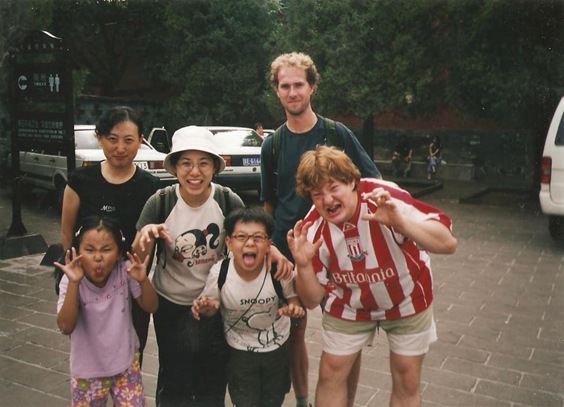
email and george At the Ming Tombs, left to right: Email’s mum, Email, George’s sister, George, the Lowlander and me

The Ming Tombs were for me, a bit of a disappointment. For a start they were crammed with people, and on top of that they were but tombs; white chambers underground with not a lot inside them. I spent most of the time playing with Email and talking to George's sister, whilst jostling with the masses.

ming tombs1 

The Ming Tombs: busy

And after that, it was more pointless waiting around at a Herbal Medicine Centre, where a doctor examined me, informed me that I liked food too much and exercise too little, and proscribed herbal remedies costing a hundred euros, and then doing the rounds of the hotels once more, since first on obviously meant last off too. Oh well, it hadn't been a bad day all in all, after all how often do you see a world famous monument and meet a kid named after an electronic postal service? But we were glad that our tour was over and we wouldn't be answerable to a guide with a penchant for jade, sliding cars and herbal remedies ever again in our lives!

But of course, whilst the tour had finished, the day itself was far from over, for the elusive Ryan had phoned late the previous evening when he'd got back to his hotel, and we had organised to meet up, so after freshening ourselves up after the rigours of a day on the Wall, we took a taxi back through the smart streets of Beijing to meet our American.

Ryan Poindexter was much as I remembered him to be, but that was hardly surprising since it was only two weeks since we'd last met up anyway. He too was enjoying the China Experience, having done the Ming Tombs (yeah, he thought they were crap too), the Wall (a quieter bit mind), Summer Palace and Forbidden City already. And like us, enjoying it all so much, he promptly agreed that it was a great idea to get as far away from any vestiges of the Middle Kingdom by going to a Turkish/ Middle Eastern restaurant to dine, thus immersing ourselves in a rather different Eastern culture to the one that surrounded us. To the Lowlander and I, the falafels, pita and humus were all rather familiar fayre, after our time spent in the Holy Land, but the stunningly beautiful belly dancers were not. One, who looked the spitting image of a Bulgarian friend of mine, was especially attractive, so I asked where she was from, but a received a disappointing reply; she hailed from the wrong end of the Black Sea, Azerbaijan, not the Balkans.

And after that it was onto an Irish bar where we quaffed ales, (boy, was I out of practice), talked travel and watched a laughably awful Chinese group who sang in a sort-of English and thought that they were the Beatles. All good stuff anyway, and a fine end to a long Beijing day.

ryan drinks Drinks with Ryan

Next part: 2d: Beijing (III)